No. 6 · Edited by Alex Vita
Living beforefridges
On paper, there were 94 “ice men”
In the Zhou li, an old Chinese book. It sets out the offices of an ideal court.
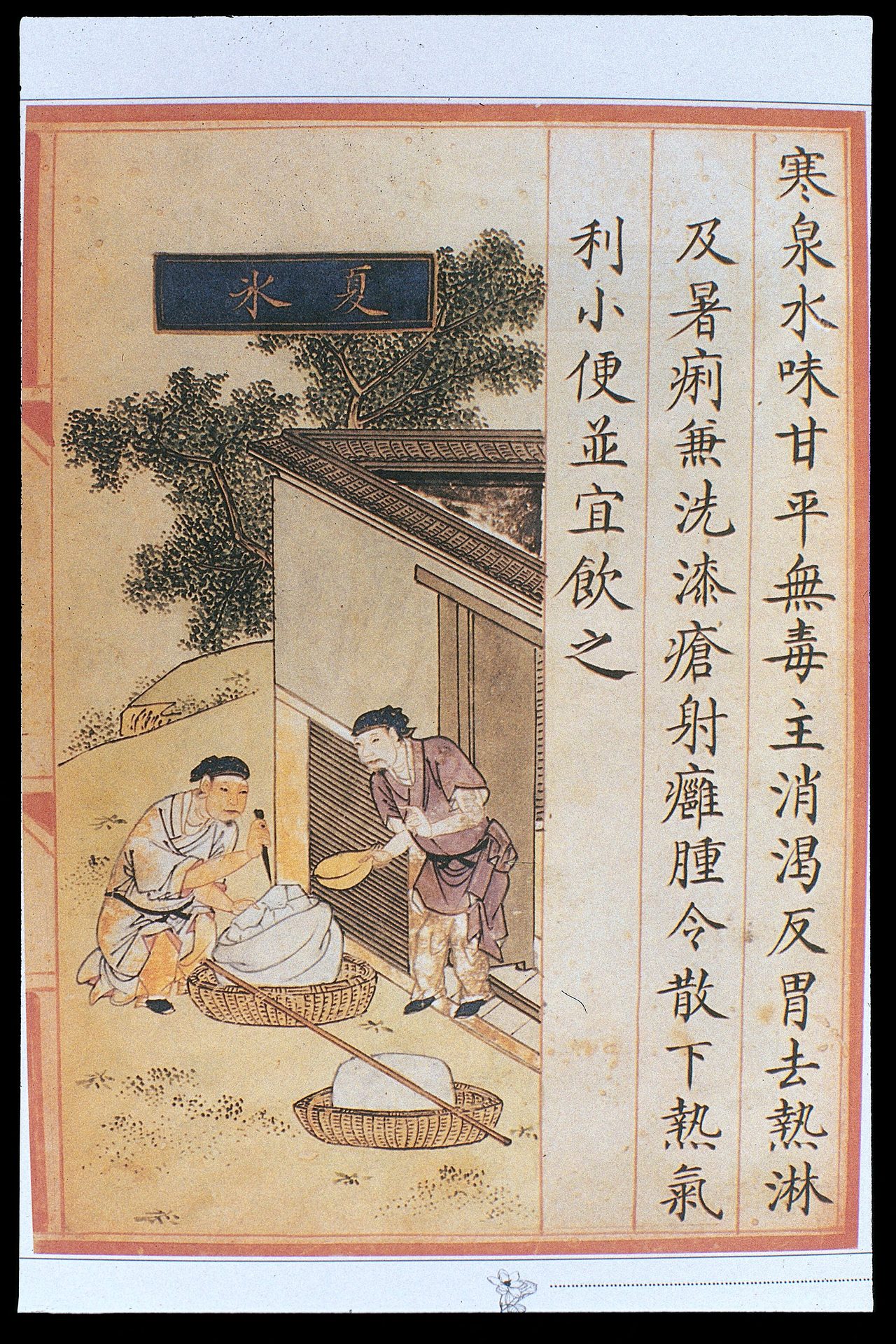
Two men take ice out of an ice store: the summer ice painting in the Shiwu bencao, a Ming food manual, 1368 to 1644.
- Image:
- Anonymous, two men take ice out of an ice store, painting from the Shiwu bencao, Ming dynasty, 1368 to 1644. Wellcome Collection. Public Domain Mark.
- Source:
- Zhou li (Rites of Zhou), Tianguan, the ice men, our translation
Most food, in the sources below, was not kept cold. It was salted, smoked, dried, or kept alive until it was wanted. Stored ice was a luxury: mostly for drinks in Persia and Mughal India, while an old Chinese book puts a court’s dishes on ice, and Virginia’s and Europe’s ice houses later chilled food too. No source we read gives a first home fridge. What China, Japan, Persia, Mughal India, Rome, Cairo, the Andes, Amsterdam and Virginia did about food and drink in the heat, with the original beside our English wherever the translation is ours.
China: ice men on paper, and a court’s dishes on ice
The Zhou li (Rites of Zhou) is an old Chinese book that sets out the offices of an ideal court. We print no date for it. Among the offices are the ice men, with their staff:
“Ice men: two junior officers; two storekeepers, two scribes, eight foremen and eighty labourers.”
Zhou li, Tianguan, the ice men. Our translation.
凌人:下士二人;府二人,史二人,胥八人,徒八十人。
That is 94 people, on paper. Their duties follow:
“The ice men are in charge of ice affairs. In the twelfth month of the year they order ice to be cut, and triple the ice store. In spring they begin to make ready the jian chests; all the dishes and delicacies of the outer and inner cooks go into the jian, and so do the wines and sweet wines of the wine and drinks offices. For sacrifices they supply ice chests; for guests they supply ice. For a great funeral they supply the ice for the yi tray. In summer, when ice is handed out, they take charge of it. In autumn they clean [the ice house] out.”
Zhou li, Tianguan, the ice men. Our translation.
凌人:掌冰政。歲十有二月,令斬冰,三其凌。春始治監,凡外內饔之膳羞,監焉。凡酒、漿之酒醴亦如之。祭祀,共冰監。賓客,共冰。大喪,共夷盤冰。夏,頒冰掌事。秋,刷。
The Zhou li says only that the ice store is tripled. The reason comes from its commentator Zheng Xuan (127 to 200), whose notes also describe the jian and the tray:
“Ling means an ice house. Tripling it allows for melting. [...] A jian is like a jar with a wide mouth, used to hold ice; food is put inside it to keep off the warm air. [...] Ice is put in the yi tray, which is set under the bed of the dead, to keep the body cold. [...] When the summer heat is strong, the king hands out ice as gifts, and the ice men see to it.”
Zheng Xuan, notes on the Zhou li, in the Zhouli zhushu, ch. 5. Our translation.
[on 三其淩] 淩,冰室也。三之者,為消釋度也。 [...] [on 春始治鑒] 鑒,如甀,大口,以盛冰,置食物於中,以禦溫氣。 [...] [on 大喪,共夷槃冰] 實冰於夷槃中,置之屍床之下,所以寒屍。 [...] [on 夏頒冰,掌事] 暑氣盛,王以冰頒賜,則主為之。
The Shijing (Book of Songs) has the ice cut and carried in:
“In the days of the second month they cut the ice, chong chong; in the days of the third they carry it into the ice house.”
Shijing, Bin feng, “Qi yue”. Our translation.
二之日鑿冰沖沖,三之日納于凌陰
The months are the old Zhou calendar’s: the last month of winter and the first of spring, when Bin, Zheng Xuan says, was still cold.
In the Zuo zhuan, under the fourth year of Duke Zhao, a hailstorm prompts a question. Shen Feng’s answer explains the hail by the way ice was stored and shared in ancient times, set against his own day:
“There was a great hailstorm. Ji Wuzi asked Shen Feng, ‘Can hail be prevented?’ He answered: ‘When a sage is on the throne there is no hail, and if there is, it does no harm. In ancient times, when the sun was in the northern station they stored ice, and when the western station appeared at dawn they brought it out. When they stored ice, they took it from deep mountains and far valleys, where the shade is deep and the cold frozen hard. When they brought it out, it was used by those who held rank and pay at court, for guests, for meals, for funerals and for sacrifices. [...] Its storing and bringing out kept to the seasons. Every salary that included meat came with ice. For great officers and titled wives, ice was used to wash the dead. [...] From titled men and titled women down to the old and the sick, no one went without ice. Mountain men took it, county men passed it on, carters brought it in, servants stored it. [...] Now they store the ice of rivers and ponds, and leave it unused.’”
Zuo zhuan, Duke Zhao, year 4, Shen Feng’s answer to Ji Wuzi, punctuated, and read 大夫 for the Wikisource text’s 大大, as the Zhouli zhushu, ch. 5, quotes it. Our translation.
大雨雹。季武子問於申豐曰:「雹可禦乎?」對曰:「聖人在上,無雹,雖有不為災。古者日在北陸而藏冰,西陸朝覿而出之。其藏冰也,深山窮谷,固陰沍寒,於是乎取之。其出之也,朝之祿位,賓食喪祭,於是乎用之。[...] 其出入也時。食肉之祿,冰皆與焉。大夫命婦,喪浴用冰。[...] 自命夫命婦,至於老疾,無不受冰。山人取之,縣人傳之,輿人納之,隸人藏之。[...] 今藏川池之冰,棄而不用。」
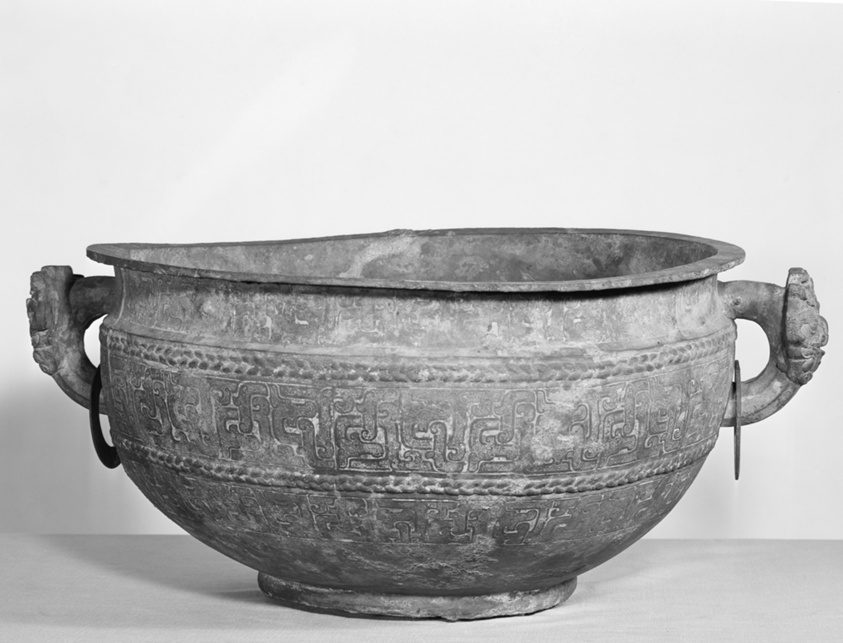
A bronze jian basin, China, first half of the 5th century BC: a vessel of the kind the Zhou li names. The Art Institute of Chicago catalogues it as a water basin, and its record says nothing about ice.
- Image:
- Water basin (jian), bronze, China, Eastern Zhou dynasty, first half of the 5th century BC. The Art Institute of Chicago, 1930.704.
- Source:
- Zhou li, Tianguan, the ice men; Zheng Xuan, Zhouli zhushu, ch. 5. Our translations

Two men gather snow into a jar: the painting for the snow water of the year’s last month in the Shiwu bencao, Ming dynasty, 1368 to 1644.
- Image:
- Anonymous, two men gather snow into a jar, painting from the Shiwu bencao, Ming dynasty, 1368 to 1644. Wellcome Collection. Public Domain Mark.
- Source:
- After Wellcome Collection’s catalogue entries for the Shiwu bencao; Shijing, “Qi yue”, our translation
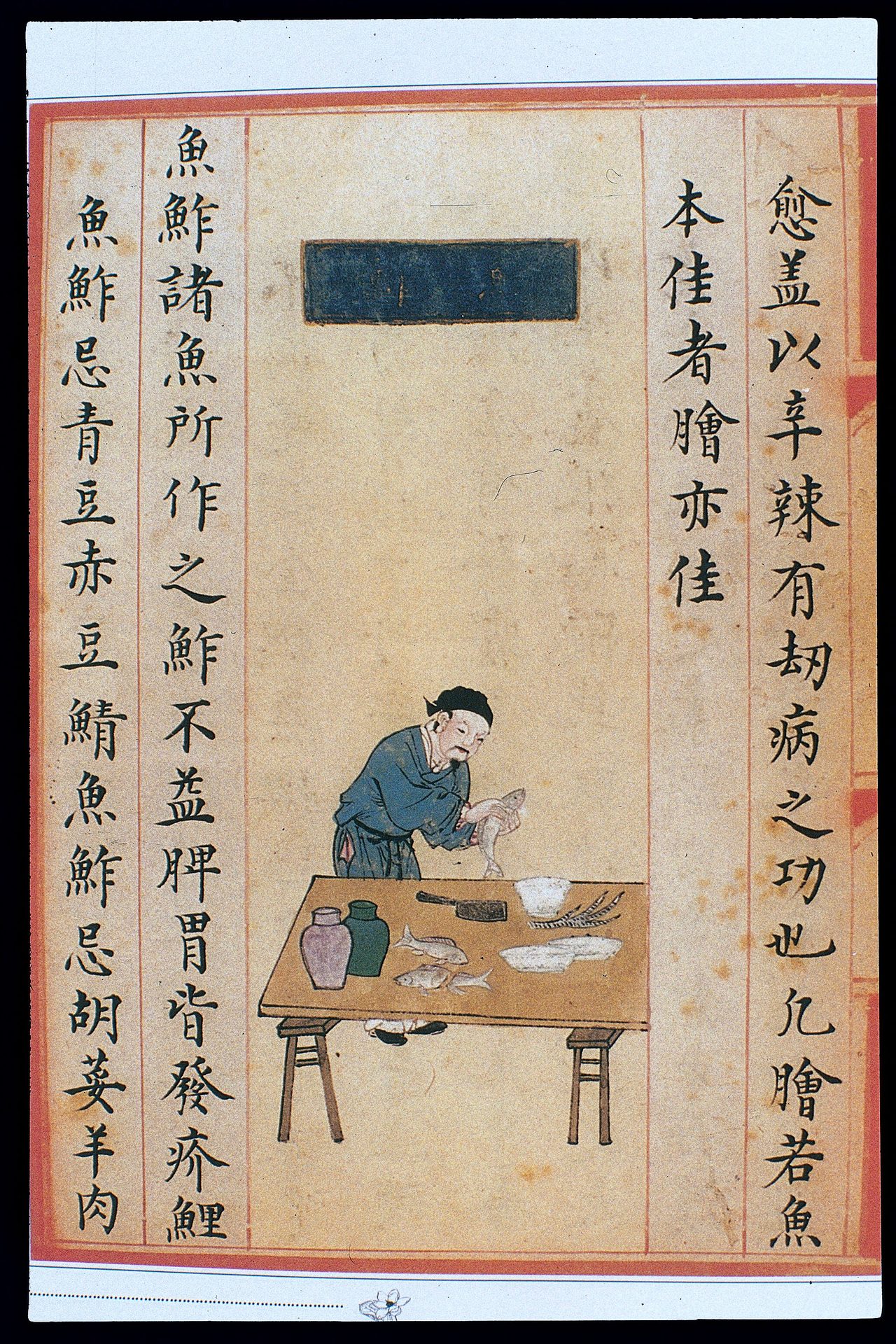
A man prepares salted fish, in the same manuscript. The label over the picture is blank or faded; the title is the Wellcome Collection’s.
- Image:
- Anonymous, a man prepares salted fish, painting from the Shiwu bencao, Ming dynasty, 1368 to 1644. Wellcome Collection. Public Domain Mark.
The people who receive ice in Shen Feng’s account are people of rank: those whose salary included meat, titled men and women, and from them down to the old and the sick. We print no year for the exchange.
A Ming food manual, the Shiwu bencao (1368 to 1644, its author and painters unknown), pictures summer ice: blocks cut from rivers and lakes in winter and kept in ice stores until summer. Snow from the last month of the year, it says, keeps fruit well (after the Wellcome Collection’s catalogue entries for the paintings). The same manuscript pictures the more usual answer, a man preparing salted fish.
Japan and Korea: an ice room in a field
A Japanese chronicle, the Nihon shoki, which is written in Chinese, tells of a prince out hunting. We print no year for him.
“That year Prince Nukata no Ōnakatsuhiko went hunting at Tsuge. From the top of a hill the prince looked out and saw something in the middle of a field, shaped like a hut. He sent a messenger to look, who came back and said, ‘It is a pit.’ So he called Ōyamanushi, the inaki of Tsuge, and asked him, ‘What [■] is that in the field?’ He answered, ‘It is an ice room.’ The prince said, ‘How is it stored, and what is it used for?’ He said, ‘Dig the earth more than a jō deep and roof it over with grass. Spread cogon grass and reeds thickly, take ice and lay it on top. It lasts through the summer months without [melting]. As for its use, in the hot months it is put into water and rice wine.’ The prince brought some of the ice and presented it at the palace. The emperor was delighted. From then on, every late winter, ice was always stored, and at the spring equinox it began to be handed out.”
Nihon shoki, vol. 11, Emperor Nintoku, year 62. Our translation.
是歳。額田大中彦皇子獵于闘鷄。時皇子自山上望之。瞻野中有物。其形如廬。仍遣使者令視。還來之曰。窟也。因喚闘鷄稻置大山主。問之曰。有其野中者何■矣。啓之曰。氷室也。皇子曰。其藏如何。亦奚用焉。曰。掘土丈餘。以草蓋其上。敦敷茅荻。取氷以置其上。既經夏月而不■。其用之。即當熱月漬水酒以用也。皇子則將來其氷。獻于御所。天皇歡之。自是以後。毎當季冬必藏氷。至于春分始散氷也。
Two characters are lost in the text we read; we mark each with ■. The first stays a marked gap in the English. For the second, “[melting]” is our supply, the sense the sentence forces. The ice in the prince’s field goes into drinks.
Miura Jōshin’s Keichō kenmonshū looks back at snow as tribute, and at a delivery that was stopped:
“In old times the snow of the ice rooms was offered to the emperor as tribute. The Water Office received it. It came up from Fuji, from the heights of Tango, and from Matsugasaki in Yamashiro. [...] And again, around the Kenchō years, in Kamakura, in the blazing heat of the sixth month, snow from Fuji was sent for and served as a rare delicacy; but it was later stopped, as a burden on the people. That was because Fuji can be seen from Kamakura.”
Miura Jōshin, Keichō kenmonshū, vol. 7, in the Kokumin bunko edition, 1912. Our translation.
昔氷室の雪を御門へ御調物に奉る。是を主水受取る。富士、丹後の頂山、山城の松が崎より上る。[...] 扨又建長の比ほひ鎌倉において六月炎暑の節に当て富士の雪を召しよせ、珍物にそなへ給ひしが、民の煩ひとて後やめられたり。鎌倉より富士見えぬる故也。
The last sentence may explain the fetching or the stopping, so we use it for neither. Kenchō is an era name, and we print no year for it.
A Korean chronicle, the Samguk sagi, records under the sixth year of King Jijeung of Silla:
“In winter, in the eleventh month, he first ordered the office in charge to store ice.”
Kim Busik, Samguk sagi, Silla annals 4, King Jijeung, year 6. Our translation.
冬十一月,始命所司藏氷
Persia: ice stacked by the quarter, sold by the donkey-load
Jean Chardin reached Isfahan on 24 June 1673 and spent the next four and a half years in Persia; Shah Abbas II had first received him in 1666 (after John Emerson, Encyclopaedia Iranica). His chapter on the Persians’ food ends with ice:
“A great deal of ice is used in Persia, as I have observed. In summer above all, everyone drinks with ice; but what is remarkable is that although in Isfahan, and even in Tabriz, which lies further north, the cold is dry and piercing, more than anywhere in France or England, most people drink with ice in winter as in summer.”
Jean Chardin, Voyages, ed. L. Langlès, Paris, 1811, vol. 4, p. 62. Our translation.
On use beaucoup de glace en Perse, comme je l'ai observé. L'été, sur-tout, chacun boit à la glace ; mais ce qui est remarquable, c'est qu'encore qu'à Ispahan, et même à Tauris, qui est plus septentrional, le froid soit sec et pénétrant, plus qu'en aucun endroit de France ou d'Angleterre, la plupart des gens boivent à la glace l'hiver comme l'été.
Then how it is made, and the night it is stacked:
“The ice is sold outside the town, in open places, and this is how they go about it. They dig a deep pit with a vat-shaped bottom, facing north, and in front of it they make squares sixteen to twenty inches deep, like so many little basins. They fill them with water in the evening, when it is starting to freeze, and in the morning, when it has all set, they break it up and smash it with rakes, and put all the pieces together in the pit, where they break them again into small pieces as best they can, for the more the ice is crushed, the better it sets. Then the squares are filled with fresh water, as the day before, and in the evening they go and water these crushed lumps in the pit with gourds fitted with handles, so that they set together better. In less than eight days of this work, kept up, they have blocks of ice five to six feet thick, and then, at night, the common people of the quarter are gathered, and with great shouts of joy, with fires lit on the edge of the pit and to the sound of instruments to spur them on, they go down into the pit, haul these masses of ice one on top of another (they call them codrouc, as if to say base or foundation), and throw water between them to make them set together. Within six weeks an ice store a toise deep or more, as long and as wide as you please, is filled with ice right to the top.”
Jean Chardin, Voyages, Paris, 1811, vol. 4, pp. 62 to 64. Our translation.
La glace se vend sur les dehors de la ville, en des lieux découverts ; et voici comme ils font : ils ouvrent une profonde fosse à fond de cuve, exposée au nord ; et au-devant, ils font des carrés profonds de seize à vingt pouces, comme autant de petits bassins. Ils les remplissent d'eau le soir, lorsqu'il commence à geler, et le matin que tout est pris, ils le cassent et mettent en pièces avec des rateaux, et mettent tous ces morceaux ensemble dans la fosse, où ils les cassent de nouveau en petits morceaux, le mieux qu'ils peuvent ; car plus la glace est concassée, mieux elle prend. Puis on remplit de nouvelle eau ces carrés, comme le jour auparavant, et le soir on va arroser avec des callebasses emmanchées ces glaçons, qui sont concassés dans la fosse, afin qu'ils prennent mieux ensemble. En moins de huit jours de ce travail continué, on a des glaçons épais de cinq à six pieds, et alors on amasse de nuit le commun peuple du quartier, qui, avec de grands cris de joie, avec des feux allumés sur le bord du fossé, et aux sons des instrumens pour les animer, descendent dans le fossé, tirent l'une sur l'autre ces masses de glace, qu'ils appellent *codrouc*, comme qui diroit *base* ou *fondement*, et jettent de l'eau entre deux pour les faire prendre ensemble. Il arrive, en six semaines de temps, qu'une glacière d'une toise et plus de profondeur, longue et large comme on voudra, est toute remplie de glace jusqu'au haut.
Chardin gives this as Persian practice, straight after naming Isfahan and Tabriz; he does not put the pit in either town. His first line says where the ice is sold, and nothing about where the pits were. The inches and feet are French units.
“Snow badly interrupts the work and causes a great deal of trouble; but as soon as it falls they throw it out and sweep it away with care, because in melting it would melt the ice too. When the ice store is full, it is covered with a kind of sea rush called bizour (byzor), which is found in Persia at the water’s edge. In summer, when the ice store is opened, it is another festival for the quarter. The ice is sold by the donkey-load, eighteen sous a load, which is made up of two blocks of ice of sixty pounds each. That comes to about two deniers a pound. The pieces and offcuts of these blocks go to the people of the quarter who helped with the work, and each comes in the morning to take his supply. What is most remarkable and most pleasing about their ice is its beauty and clearness. You see not the least dirt or cloudiness in it. Spring water is no clearer, nor more transparent.”
Jean Chardin, Voyages, Paris, 1811, vol. 4, p. 64. Our translation.
La neige interrompt fort l'ouvrage, et donne bien de la peine ; mais dès qu'elle survient, on la jette et on la ballaie avec soin, parce qu'en se fondant elle fonderoit aussi la glace. Quand la glacière est remplie, on la couvre d'une sorte de jonc marin, qu'on appelle *bizour* (*byzor*); qui se trouve en Perse, sur le bord des eaux. L'été, quand on va ouvrir la glacière, c'est une autre fête pour le quartier. On vend la glace par charge d'âne, dix-huit sols la charge, qui est faite de deux quartiers de glace, chacun de soixante livres pesant. C'est environ deux deniers la livre. Les morceaux et retailles de ces pièces de glaces sont pour le peuple du quartier qui a aidé à travailler, et chacun vient le matin en prendre sa provision : ce qu'il y a de plus remarquable et de plus agréable dans leur glace, c'est la beauté et la netteté. Vous n'y voyez pas la moindre saleté ni obscurité. L'eau de roche n'est pas plus claire, ni plus transparente.
The pounds are French livres. The offcuts go to the people who helped, not to the whole quarter.
“Snow is kept too, in places where that can be done conveniently, though there is ice in plenty; this is done out of refinement, because they find drink more pleasant with snow than with ice, and above all sherbet. They also know sweet preparations made with ice, roughly like the ones we take, and they call them berf, snow.”
Jean Chardin, Voyages, Paris, 1811, vol. 4, p. 64; the second sentence is the footnote of his editor, L. Langlès. Our translation.
On conserve aussi de la neige dans les lieux où on le peut faire commodément, quoiqu'il y ait de la glace en abondance ; ce qui se fait par délicatesse, parce qu'ils trouvent la boisson plus agréable à la neige qu'à la glace, et sur-tout le sorbet (*). [footnote] (*) Ils connoissent aussi des préparations sucrées à la glace, semblables, à-peu-près, à celles que nous prenons, et ils les nomment *berf*, neige. (L-s.)
Chardin’s sorbet is the Persian sweet drink, sherbet. The sweet preparations are Langlès’s note of 1811, not Chardin’s, and may be sweets chilled with ice.
Hemming Jørgensen mapped 129 Persian ice houses on the Central Plateau between 2007 and 2009. They stored ice for local distribution in summer. Tehran once had more than 80 and Isfahan more than 40, figures he takes from Vahid Qobādiān, and some villages held festivals at the filling and the opening until the second half of the 20th century (after Jørgensen, “Yakhchāl”, Encyclopaedia Iranica, 2012).
A Persian geography that Langlès quotes in a note, the Nuzhat al-qulub, says of Kashan:
“It is fairly hot in Kashan; [...] In winter it is not cold enough for there to be much ice, which is why frozen water is kept in wells, to be used in the hot season.”
The Nuzhat al-qulub, in L. Langlès’s French, note to Chardin, Voyages, Paris, 1811, vol. 3, p. 7. Our translation.
il fait assez chaud à Kâchân ; [...] En hiver, il ne fait pas assez froid pour qu'il y ait de la glace en quantité ; c'est pourquoi on conserve de l'eau gelée dans les puits, pour s'en servir dans les chaleurs.
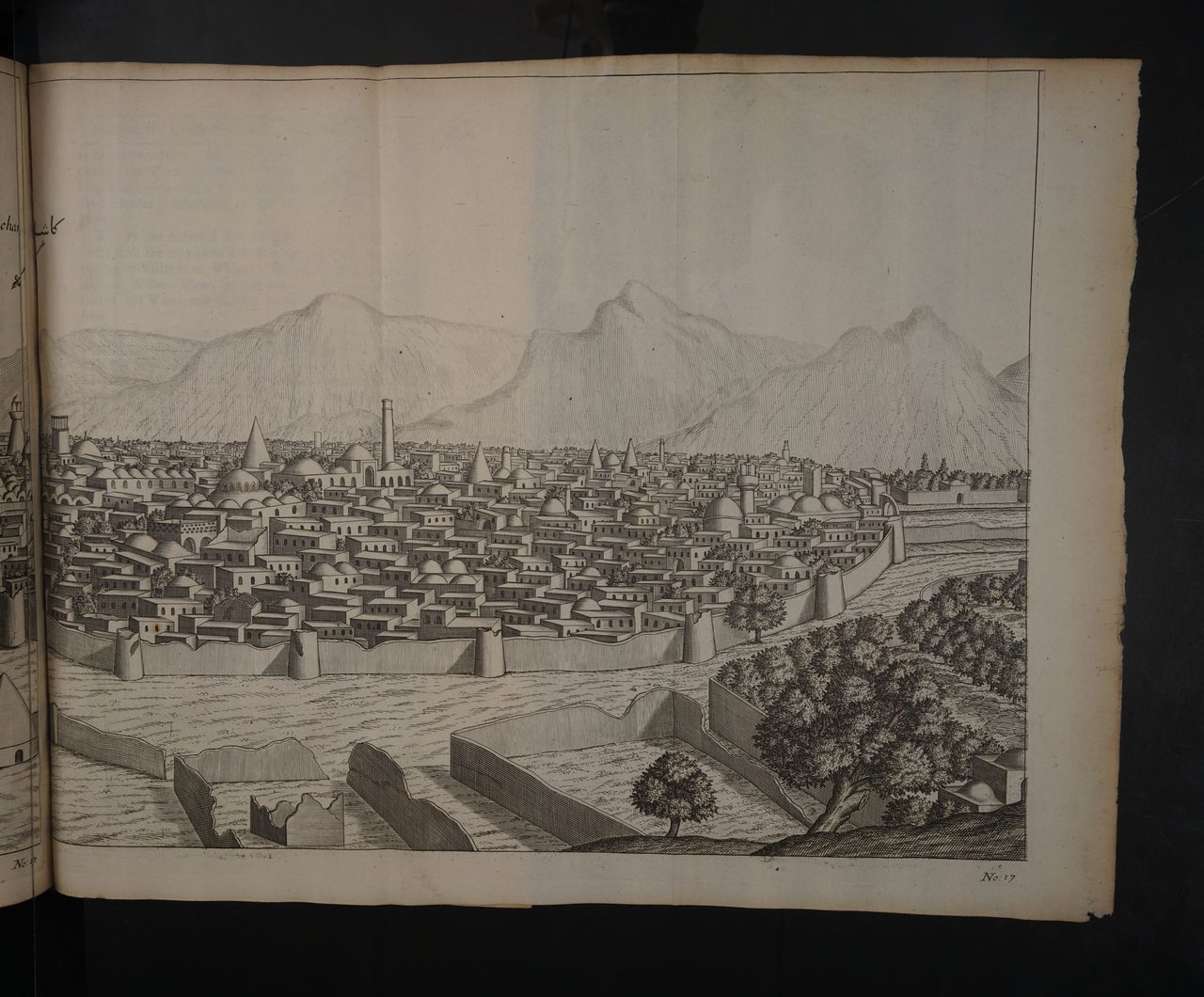
Kashan as Chardin’s artist drew it, in the London edition of his travels printed in 1691 (first published in 1686). It shows the town: neither the plate nor the text beside it names an ice house.
- Image:
- After a drawing made for Jean Chardin, a view of Kashan, engraving, London, 1691. Wellcome Collection. Public Domain Mark.
- Source:
- Chardin, Voyages (Paris, 1811), vol. 4, pp. 63 to 64; the Nuzhat al-qulub in Langlès’s note, vol. 3, p. 7. Our translations
That is two removes from the Persian, and we print no date for it.
Mughal India: ice by boat, and saltpetre
The Ain-i Akbari of Abu’l Fazl files ice under the court’s water department, in its Ain 22. In the translation of H. Blochmann (Calcutta, 1873): “Since the thirtieth year of the Divine Era, when the imperial standards were erected in the Panjáb, snow and ice have come into use. Ice is brought by land and water, by post carriages or bearers, from the district of Panhán, in the northern mountains, about forty-five kós from Láhór.” Blochmann’s note on the thirtieth year reads “A. D. 1586”; another of his notes dates the writing to 1596. The supply ran to a timetable: “Out of the ten boats employed for the transport of ice, one arrives daily at the capital, each being manned by four boatmen.” On who used it the Ain says only this: “All ranks use ice in summer; the nobles use it throughout the whole year.”
The same Ain has a way to cold water with no ice in it: “Saltpetre, which in gunpowder produces the explosive heat, is used by his Majesty as a means for cooling water, and is thus a source of joy for great and small.” A metal goglet of water “is stirred about for a quarter of an hour, when the water in the goglet will become cold.”
Blochmann added a footnote of his own in 1873: “Here, in Calcutta, one sér of American ice costs two annas”. American is his word; he names no shipper.
Mari, Alexander and Rome: an ice house, snow trenches, snow water
Zimri-Lim, king of Mari, had it written that he built an ice house at Terqa, something no king on the bank of the Euphrates had built before. Writings from Mari hold the first known mentions of an ice house, by Jørgensen’s account; those ice houses were probably cellars inside palaces, and their main use seems to have been cooling the king’s wine (after the CDLI text of the inscription, and Jørgensen, Encyclopaedia Iranica, 2012). We print no date for Zimri-Lim.
Athenaeus cites Chares of Mitylene on Alexander at the siege of Petra in India: “ὀρύξαι φάσκων τὸν Ἀλέξανδρον [ὀρύγματα] τριάκοντα ψυχεῖα, ἃ πληρώσαντα χιόνος παρεμβαλεῖν δρυὸς κλάδους. οὕτω γὰρ παραμένειν πλείω χρόνον τὴν χιόνα”, “Alexander dug thirty large trenches close to one another, and filled them with snow, and then he heaped on the snow branches of oak; for that in that way snow would last a long time.” (Deipnosophistae 3.124c, Greek ed. Kaibel, who brackets ὀρύγματα; tr. C. D. Yonge, 1854).
Pliny the Elder, on an emperor’s cold water:
“It was the emperor Nero’s invention to boil water and chill it in glass lowered into snow; in this way one has the pleasure of the cold without the faults of snow.”
Pliny the Elder, Natural History 31.40. Our translation.
Neronis principis inventum est decoquere aquam vitroque demissam in nives refrigerare; ita voluptas frigoris contingit sine vitiis nivis.
And on who drank what: “hi nives, illi glaciem potant poenasque montium in voluptatem gulae vertunt”, “Some drink snow, others ice, and they turn the punishments of the mountains into a pleasure for the gullet.” (Pliny the Elder, Natural History 19.55, our translation).
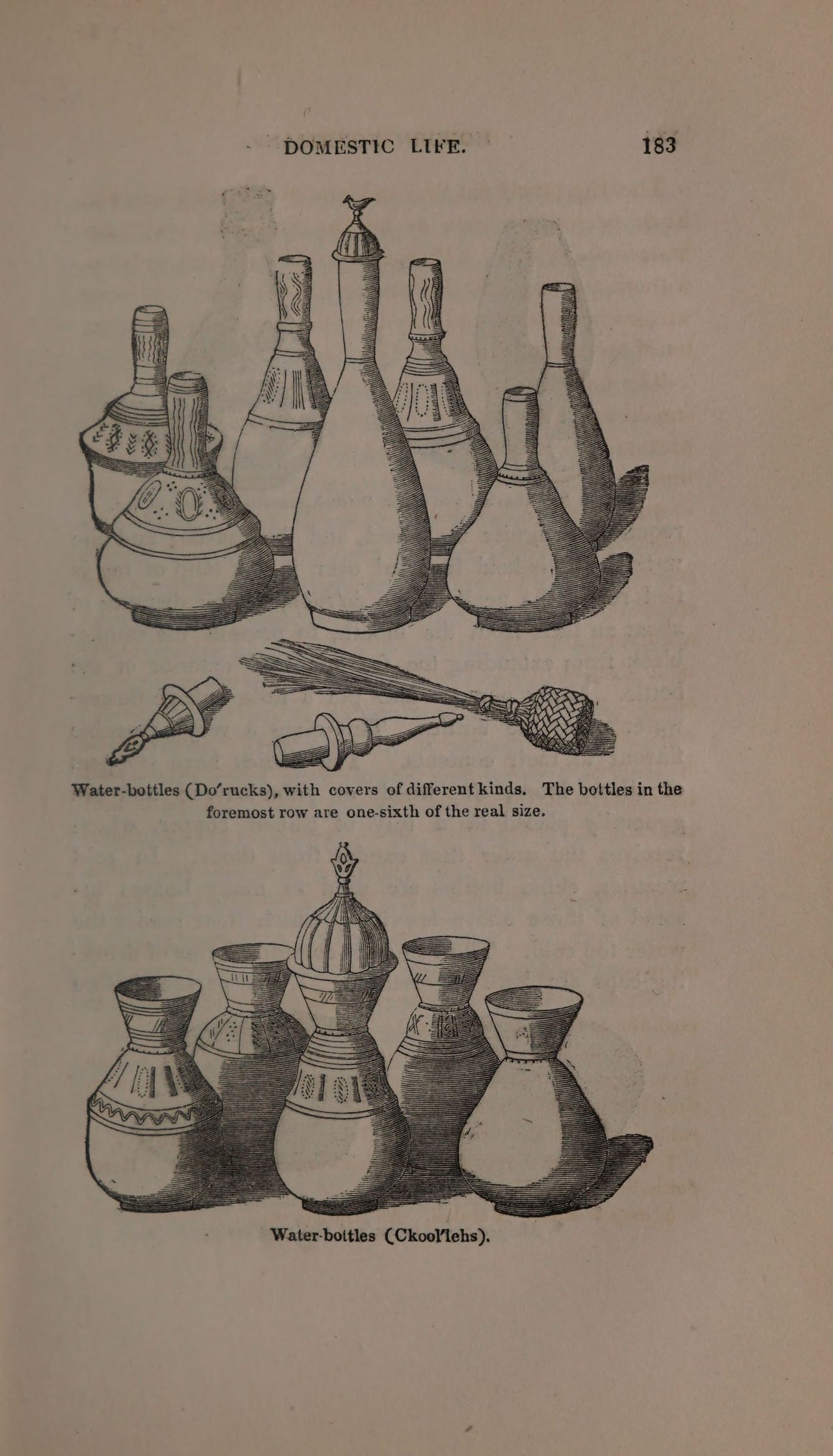
Lane’s two woodcuts of Cairo water-bottles, 1836: Do′rucks above, Ckool′lehs below. The woodcuts show the bottles; the cooling is his claim on the page before.
- Image:
- E. W. Lane, Cairo water-bottles, wood engravings in his Manners and Customs of the Modern Egyptians, 1836. Wellcome Collection. Public Domain Mark.
- Source:
- Lane, Modern Egyptians (London, 1836), vol. 1, p. 182; Abu’l Fazl, Ain-i Akbari, Ain 22, H. Blochmann, tr., Calcutta 1873
Cairo, the 1830s: jars in a current of air
Edward William Lane published his account of the modern Egyptians in London in 1836. The water-bottles of Cairo, he wrote, “are made of a greyish, porous earth, which cools the water deliciously, by evaporation; and they are, therefore, generally placed in a current of air.” A small projecting lattice holds such bottles: “Hence the name of ‘meshrebee′yeh,’ which signifies ‘a place for drink,’”. A watermelon is cut up and “left to cool in the external air, or in a current of air, by the evaporation of the juice on the surfaces of the slices; but it is always watched during this time, lest a serpent should come to it, and poison it by its breath or bite”. Lane reports the watching as what people in Cairo did; the serpent’s breath is their belief, not his finding.
The Andes: the potato that changes its name
Garcilaso de la Vega, in the Comentarios reales, writes of the whole province called Colla. In Clements R. Markham’s translation of 1871: “Among these there is one called papa, round and moist, and inclined to rot soon, on account of its moistness. To preserve it, they put it in the earth, and cover it with a very good kind of grass that grows in the fields there. They leave it for many nights exposed to the frost, for it freezes hard throughout the year in that province. As soon as the frost is passed, they cover the papas with straw, and press them gently to squeeze out all moisture, both that naturally existing and that caused by the frost. After they have been well pressed, they expose them to the sun until they have been completely dried. Prepared in this way the papa will keep for a long time; its name is then changed, and it is called a chuñu. This is the way all the papas were treated that were gathered from the lands of the Sun and the Ynca; and they were then stored in the depôts with the other provisions.”
José de Acosta, whose book was published in Seville in 1590, has the trade:
“They gather these potatoes and leave them to dry well in the sun, and by breaking them up they make what they call chuño, which keeps like that for many days and serves them as bread; and in that kingdom the trade in this chuño for the mines of Potosí is a great one.”
José de Acosta, Historia natural y moral de las Indias, Seville, 1590, Book 4, ch. 17, in the Madrid reprint of 1894. Our translation.
Estas papas cogen, y déjanlas secar bien al Sol, y quebrantándolas hacen lo que llaman chuño, que se conserva así muchos dias, y les sirve de pan, y es en aquel Reino gran contratación la de este chuño para las minas del Potosí.
And on the province of the Collao:
“but they make up for the lack of bread with some roots they sow, called papas, which grow under the ground; these are the Indians’ food, and by drying and curing them they make from them what they call chuño, which is the bread and food of that land.”
José de Acosta, Historia natural y moral de las Indias, Seville, 1590, Book 3, in the Madrid reprint of 1894. Our translation.
pero suplen la falta de pan con unas raíces que siembran, que llaman papas, las cuales debajo de la tierra se dan, y estas son comida de los Indios, y secándolas y curándolas hacen de ellas lo que llaman chuño, que es el pan y sustento de aquella tierra.
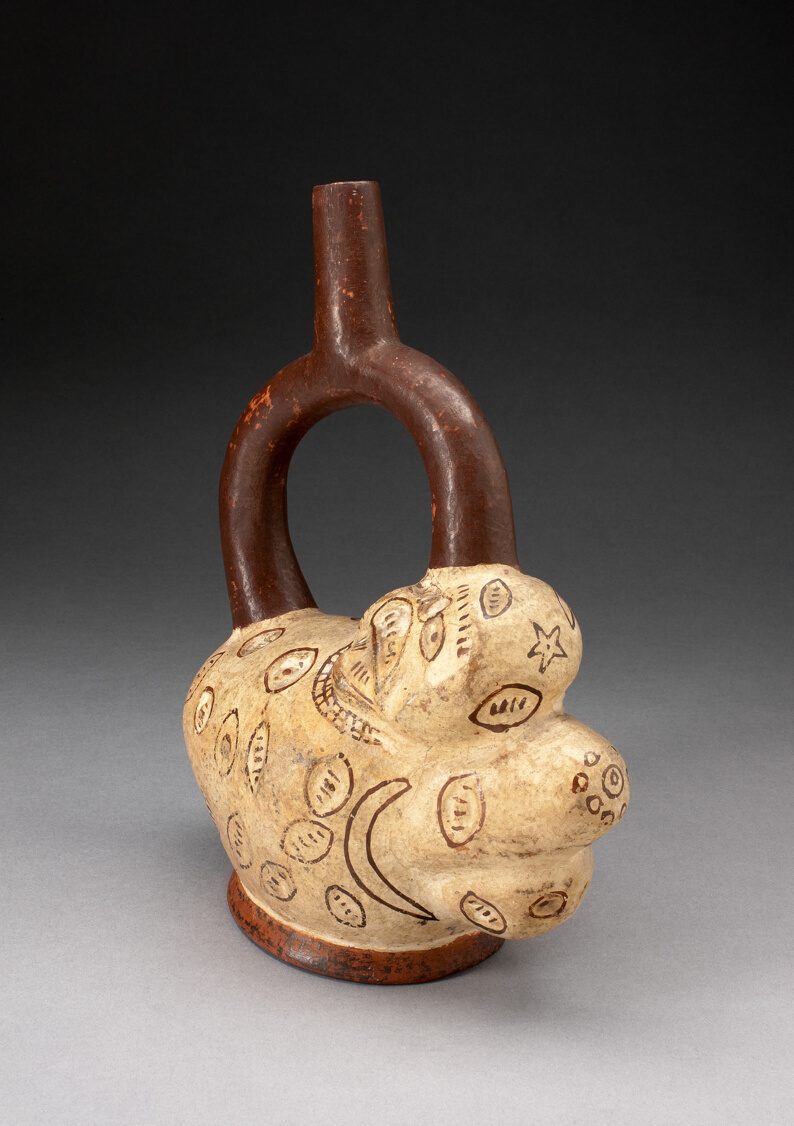
A Moche vessel in the form of a potato, north coast of Peru, 100 BCE to 500 CE; the painted marks are probably eyes, by the Art Institute of Chicago’s title. It shows the potato, not chuño.
- Image:
- Moche, a spouted vessel in the form of a potato, ceramic and pigment, north coast of Peru, 100 BCE to 500 CE. The Art Institute of Chicago, 1958.710.
- Source:
- Garcilaso de la Vega, Comentarios reales, Book 5, ch. 5, tr. Clements R. Markham (1871)
Acosta’s chuño is dried in the sun, and he names no frost in the making. The frost and the pressing are Garcilaso’s.
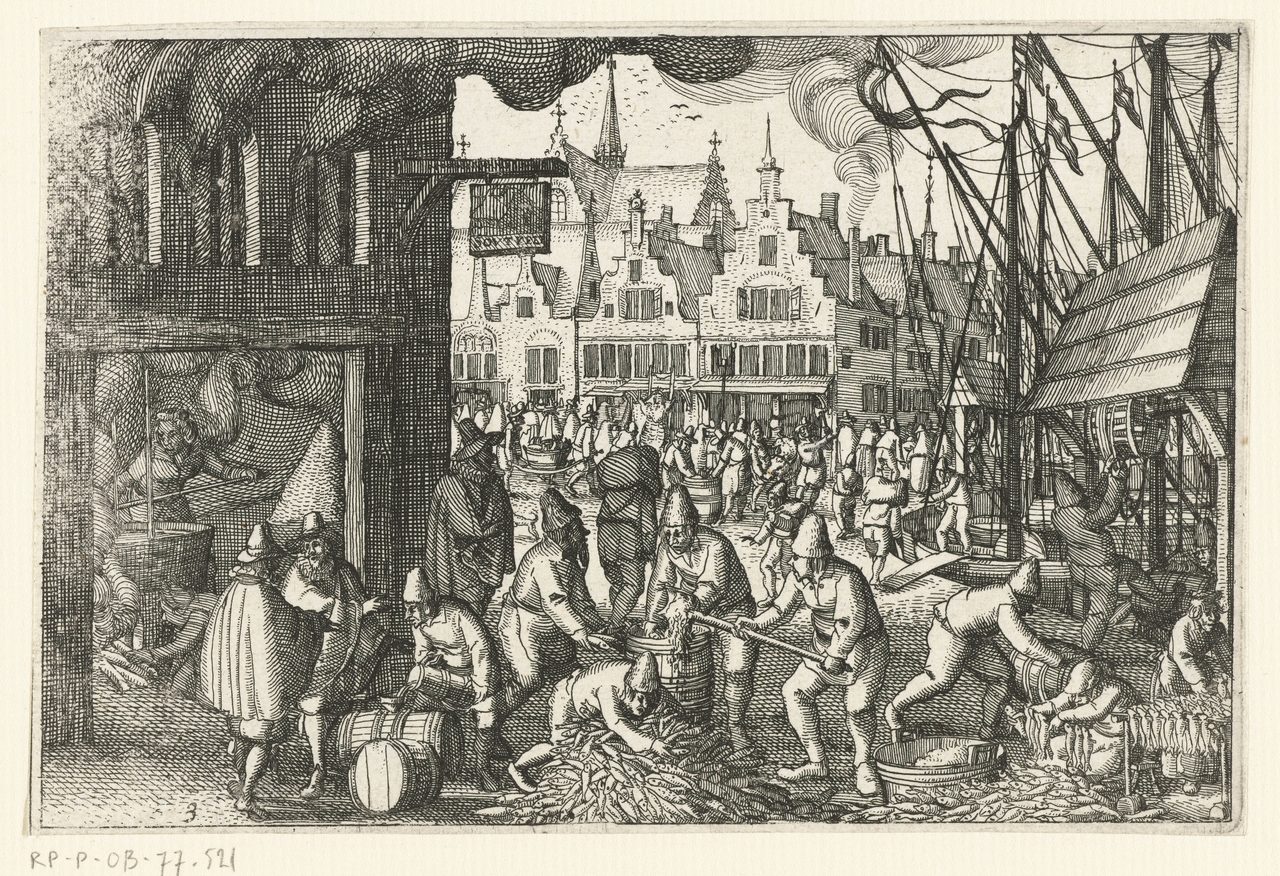
Herring gutted, smoked and packed in barrels by the Haringpakkerstoren, Amsterdam, in an etching by Claes Jansz. Visscher, 1608.
- Image:
- Claes Jansz. Visscher, herring gutted, smoked and packed in barrels, etching, 1608. Rijksmuseum, RP-P-OB-77.521.
- Source:
- After A. Hostetter, eHumanista 25 (2013); William Cobbett, Cottage Economy (London, 1822), §139
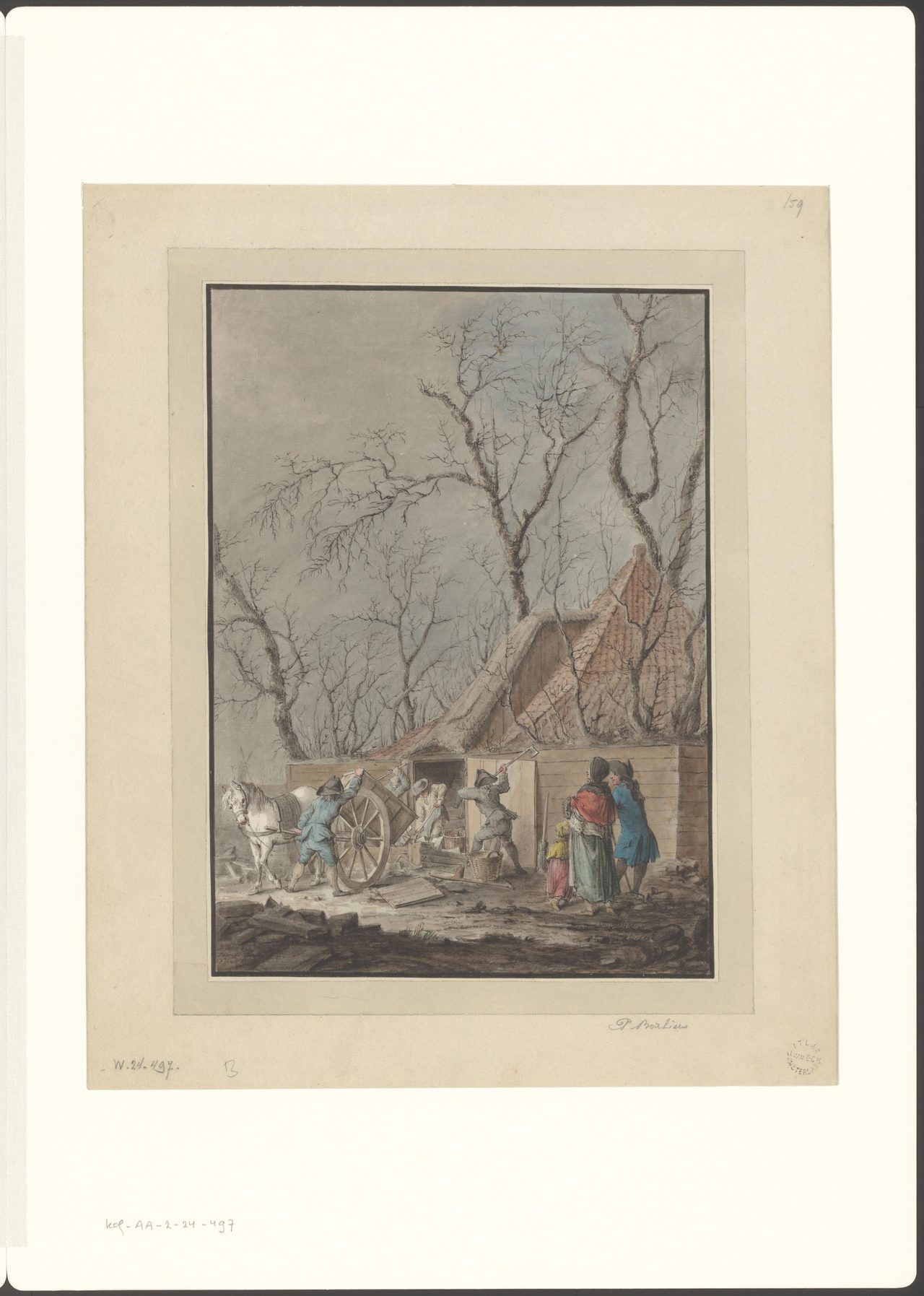
An ice cellar in winter, Amsterdam, drawn by Pieter Barbiers, 1727 to 1780: a cart is tipped at the door, where men work with a spade and an axe, unloading what looks like ice. The record’s title says only an ice cellar.
- Image:
- Pieter Barbiers, an ice cellar in winter, pen and watercolour, Amsterdam, 1727 to 1780. Rijksmuseum, KOG-AA-2-24-497.
- Source:
- After H. Jørgensen, “Yakhchāl”, Encyclopaedia Iranica (2012); William Cobbett, Cottage Economy (London, 1822), §149
Europe and Virginia: salt, smoke, and an ice house for ten dollars
In Claes Jansz. Visscher’s print of 1608, herring is gutted in the foreground, a smokehouse with a sign reading Souterij stands on the left, and in the middle the fish are packed into barrels (after the Rijksmuseum’s record).
For people who could afford it, animals and even fish were often kept alive until the moment they were wanted, and in La Varenne’s recipes (1652 edition) the opposite of “fresh”, for fish or meat, was usually “salted” (after Aaron Hostetter, eHumanista 25, 2013).
William Cobbett’s Cottage Economy (London, 1822) is firm about the pig: “A couple of flitches of bacon are worth fifty thousand methodist sermons and religious tracts.” His flitches cure in a salting-trough with a gutter, never “sopping in brine”. He has rules for ice too: “an ice-house should never be under ground, nor under the shade of trees”. In Virginia, he writes, “they keep their fish and meat as fresh and sweet as in winter”, and “A Virginian, with some poles and straw, will stick up an ice-house for ten dollars”. Then, of England: “It is very hard to imagine, indeed, what any one should want ice for in a country like this”.
Europe’s ice houses were used to keep drinks and food cold, by Jørgensen’s account in the Encyclopaedia Iranica.
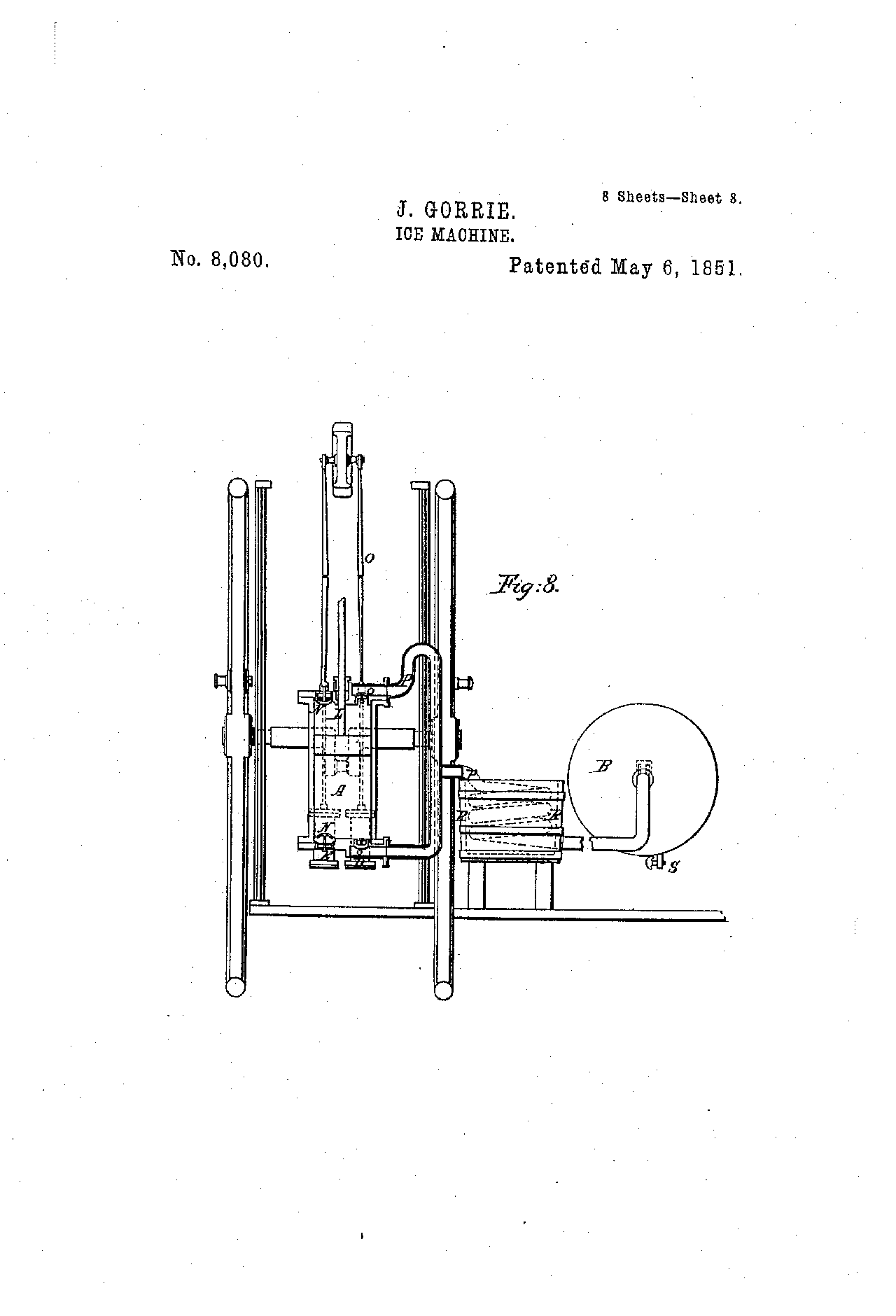
Sheet 8 of John Gorrie’s ice machine patent, US 8,080, 6 May 1851: a pump between two flywheels, with pipes to a tank of coils and a reservoir.
- Image:
- John Gorrie, Ice Machine, US Patent 8,080, drawing, 6 May 1851. United States Patent and Trademark Office.
- Source:
- Tudor’s letter, Bulletin of the Business Historical Society 6.4 (1932); US Patent 8,080; Evening Post (Wellington), 26 February 1926
No first home fridge, only dated markers
The sources we read give no first fridge in a home. They give dated things, and each shows the change unfinished.
Boston, 10 December 1805. Frederic Tudor writes to a cousin: “William & myself have formed a plan of carrying Ice to the west Indies”. He has done the sum, “By calculation the ice will cost us there not much over a cent a pound!”, and weighed the risk: “If we fail, which is next to an impossibility, the loss is trifling.” On 4 August 1852 he looked back on the first cargo, which went “in a Brig, belonging to myself bound for S. Pierre, Martinique”, in February 1806 by his count. Wherever ice was brought in, to places of sufficient population and prosperity, he wrote, “it has been unsuccessful at first”. By 1835 Tudor was shipping ice to Calcutta, and at one time he had ice houses in Havana, Jamaica, New Orleans, Charleston, Mobile, Calcutta, Madras, Bombay, Galle and Singapore (after the editor of his letters, 1932).
Walden Pond, the winter of 1846 to 1847. Henry David Thoreau: “In the winter of ’46-7 there came a hundred men of Hyperborean extraction swoop down on to our pond one morning”. He asks, “Why is it that a bucket of water soon becomes putrid, but frozen remains sweet forever?”, and concludes: “Thus it appears that the sweltering inhabitants of Charleston and New Orleans, of Madras and Bombay and Calcutta, drink at my well.” That is his claim, not a shipping record. Much of one heap of the pond’s ice, he also writes, “never got to market”; what was not carried off “was not quite melted till September 1848”.
6 May 1851. John Gorrie, “of the city of New Orleans”, is granted US patent 8,080 for “a new and useful Machine for the Artificial Production of Ice and for General Refrigeratory Purposes”. A patent proves a patent; nothing we read says his machine reached a home.
Wellington, 26 February 1926. Under the heading “Ice for the Home”, the Evening Post printed a cable from London, dated the day before, about an invention “demonstrated to doctors and scientists at the Savoy Hotel”. By the cable, “the inventors are two young students of the Stockholm University”; it does not name them. The paper then added a note of its own: “the invention described is not a novelty”. It went on: “such machines have been freely advertised in the United States for a considerable time and one is in operation in the Dunedin exhibition”. The paper guessed that the demonstration was “presumably staged” because rules on preservatives in dairy produce “would compel Britain to adopt the American habit of using ice-boxes for keeping food”. We read the piece as the scan’s machine-read text, which has no capitals, so the capitals in these quotations are ours.
The stories that don’t hold up
- “Before fridges, ice was only for drinks.”
Mostly, in Persia and Mughal India. But the Zhou li puts all the dishes of the outer and inner cooks into the ice chests, Cobbett’s Virginians keep fish and meat in their ice houses, and Europe’s ice houses held food as well as drinks.
- “Persia’s ice houses were fridges for food.”
Jørgensen, in the Encyclopaedia Iranica: “they were not used for refrigerating foodstuff”. The yakhchāl was an ice store, and its ice was for local distribution in summer. Nor is there a date for a first one: pits seem to go back to the 1st millennium BCE, but, by Jørgensen’s account, no evidence shows how pits became ice houses, and Europeans first mention Iran’s ice houses in the 17th century.
- “Medieval cooks used spices to hide rotten meat.”
Aaron Hostetter calls the story “hardly more than a myth of the modern age”. Animals were often kept alive until they were needed, and spices would not cover the taste or smell of spoiled meat, a point he takes from Paul Freedman.
- “Nero invented ice cream.”
Pliny credits Nero with boiled water chilled in glass lowered into snow. There is no cream in the sentence, and no sugar.
- “Chuño is freeze-dried.”
Garcilaso’s potatoes are left in the frost, pressed under straw and dried in the sun. Acosta names only the sun. Frozen, pressed and dried is as far as the sources go.
- “Frederic Tudor invented shipping ice.”
His own letter of 1805 collects earlier reports: ice “carried every year to S. Eustatius”, ice reaching the West Indies “on the ends of boards”, and a captain who took Norway ice to London.
- “The fridge was invented in the 1920s.”
Gorrie patented an ice and refrigerating machine in 1851, and in 1926 a Wellington paper called the machine shown at the Savoy “not a novelty”.
Sources
- Zhou li (Rites of Zhou), Tianguan, the ice men (凌人).
- Zheng Xuan (127 to 200), notes on the Zhou li, in the Zhouli zhushu, ch. 5 ; his dates, Library of Congress.
- Shijing (Book of Songs), Bin feng, “Qi yue”.
- Zuo zhuan, Duke Zhao, year 4.
- Wellcome Collection, catalogue entries for the Shiwu bencao paintings: wellcomecollection.org ; wellcomecollection.org ; wellcomecollection.org.
- Nihon shoki, vol. 11, Emperor Nintoku, year 62.
- Miura Jōshin, Keichō kenmonshū, vol. 7 (Kokumin bunko edition, 1912).
- Kim Busik, Samguk sagi, Silla annals 4, King Jijeung, year 6.
- Jean Chardin, Voyages du chevalier Chardin en Perse, et autres lieux de l’Orient, new edition by L. Langlès (Paris: Le Normant, 1811), vol. 4, pp. 62 to 64, and vol. 3, p. 7, page images of the Wellcome Collection’s copy: iiif.wellcomecollection.org ; iiif.wellcomecollection.org.
- John Emerson, “Chardin, Sir John”, Encyclopaedia Iranica.
- Hemming Jørgensen, “Yakhchāl”, Encyclopaedia Iranica (2012).
- Abu’l Fazl, Ain-i Akbari, Ain 22, tr. H. Blochmann (Calcutta: Baptist Mission Press, for the Asiatic Society of Bengal, 1873), vol. 1, pp. 55 to 56.
- Zimri-Lim’s inscription, CDLI text of RIME 4.06.12.03.
- Athenaeus, Deipnosophistae 3.124c, Greek ed. Kaibel, Perseus Digital Library ; tr. C. D. Yonge (London: Bohn, 1854), vol. 1, p. 205, page images of the Wellcome Collection’s copy.
- Pliny the Elder, Naturalis Historia 31.40 and 19.55, ed. Mayhoff, Perseus Digital Library.
- Edward William Lane, An Account of the Manners and Customs of the Modern Egyptians (London: C. Knight, 1836), vol. 1, pp. 9, 181 and 182.
- Garcilaso de la Vega, First Part of the Royal Commentaries of the Yncas, tr. Clements R. Markham (London: Hakluyt Society, 1871), vol. 2, p. 17.
- José de Acosta, Historia natural y moral de las Indias (Seville, 1590), Madrid reprint of 1894, vol. 1, pp. 258 and 361.
- Rijksmuseum, record of Visscher’s print, RP-P-OB-77.521.
- Aaron Hostetter, “Spoiled or Splendid?”, eHumanista 25 (2013).
- William Cobbett, Cottage Economy (London: C. Clement, 1822), §139 and §149.
- Frederic Tudor, letters of 10 December 1805 and 4 August 1852, with the editor’s introduction, Bulletin of the Business Historical Society 6.4 (September 1932).
- Henry David Thoreau, *Walden; or, Life in the Woods* (Boston: Ticknor and Fields, 1854), “The Pond in Winter”.
- John Gorrie, US patent 8,080, 6 May 1851.
- “Ice for the Home”, Evening Post (Wellington), 26 February 1926.
Images
- Anonymous, two men take ice out of an ice store, painting from the Shiwu bencao, Ming dynasty, 1368 to 1644. Wellcome Collection. Public Domain Mark. Held by Wellcome Collection, London, L0039357.
- Water basin (jian), bronze, China, Eastern Zhou dynasty, first half of the 5th century BC. The Art Institute of Chicago, 1930.704. Held by The Art Institute of Chicago, CC0.
- Anonymous, two men gather snow into a jar, painting from the Shiwu bencao, Ming dynasty, 1368 to 1644. Wellcome Collection. Public Domain Mark. Held by Wellcome Collection, London, L0039354.
- After a drawing made for Jean Chardin, a view of Kashan, engraving, London, 1691. Wellcome Collection. Public Domain Mark. Held by Wellcome Collection, London, b30325006, plate No. 17.
- E. W. Lane, Cairo water-bottles, wood engravings in his Manners and Customs of the Modern Egyptians, 1836. Wellcome Collection. Public Domain Mark. Held by Wellcome Collection, London, b29287145, vol. 1, p. 183.
- Moche, a spouted vessel in the form of a potato, ceramic and pigment, north coast of Peru, 100 BCE to 500 CE. The Art Institute of Chicago, 1958.710. Held by The Art Institute of Chicago, CC0.
- Claes Jansz. Visscher, herring gutted, smoked and packed in barrels, etching, 1608. Rijksmuseum, RP-P-OB-77.521. Held by Rijksmuseum, Amsterdam, Public Domain Mark.
- Pieter Barbiers, an ice cellar in winter, pen and watercolour, Amsterdam, 1727 to 1780. Rijksmuseum, KOG-AA-2-24-497. Held by Rijksmuseum, Amsterdam, Public Domain Mark, on loan from the Koninklijk Oudheidkundig Genootschap.
- John Gorrie, Ice Machine, US Patent 8,080, drawing, 6 May 1851. United States Patent and Trademark Office. Held by United States Patent and Trademark Office, public domain as a US patent of 1851.
- Anonymous, a man prepares salted fish, painting from the Shiwu bencao, Ming dynasty, 1368 to 1644. Wellcome Collection. Public Domain Mark. Held by Wellcome Collection, London, L0039384.
We found no open image of a Persian ice house, of ice being made or of an ice seller, so Persia’s picture is Chardin’s view of Kashan, captioned as the town. We found no open image of chuño being made: the Moche vessel shows the potato. We found no open image of an ice boat, of the Mughal water department or of water chilled with saltpetre, and none of a Japanese ice room, so Mughal India and Japan have no picture of their own. We found no open picture of Tudor’s ice ships, of Walden’s ice harvest or of the machine shown at the Savoy in 1926. The two photographs from the Art Institute of Chicago, of the bronze basin and the potato vessel, are small files, never shown much larger than their own size.