No. 4 · Edited by Alex Vita
Living beforenail clippers
A marquis faked a lost nail clipping
Marquis Zhao of Han, in the Han Feizi. It was a test of those around him.
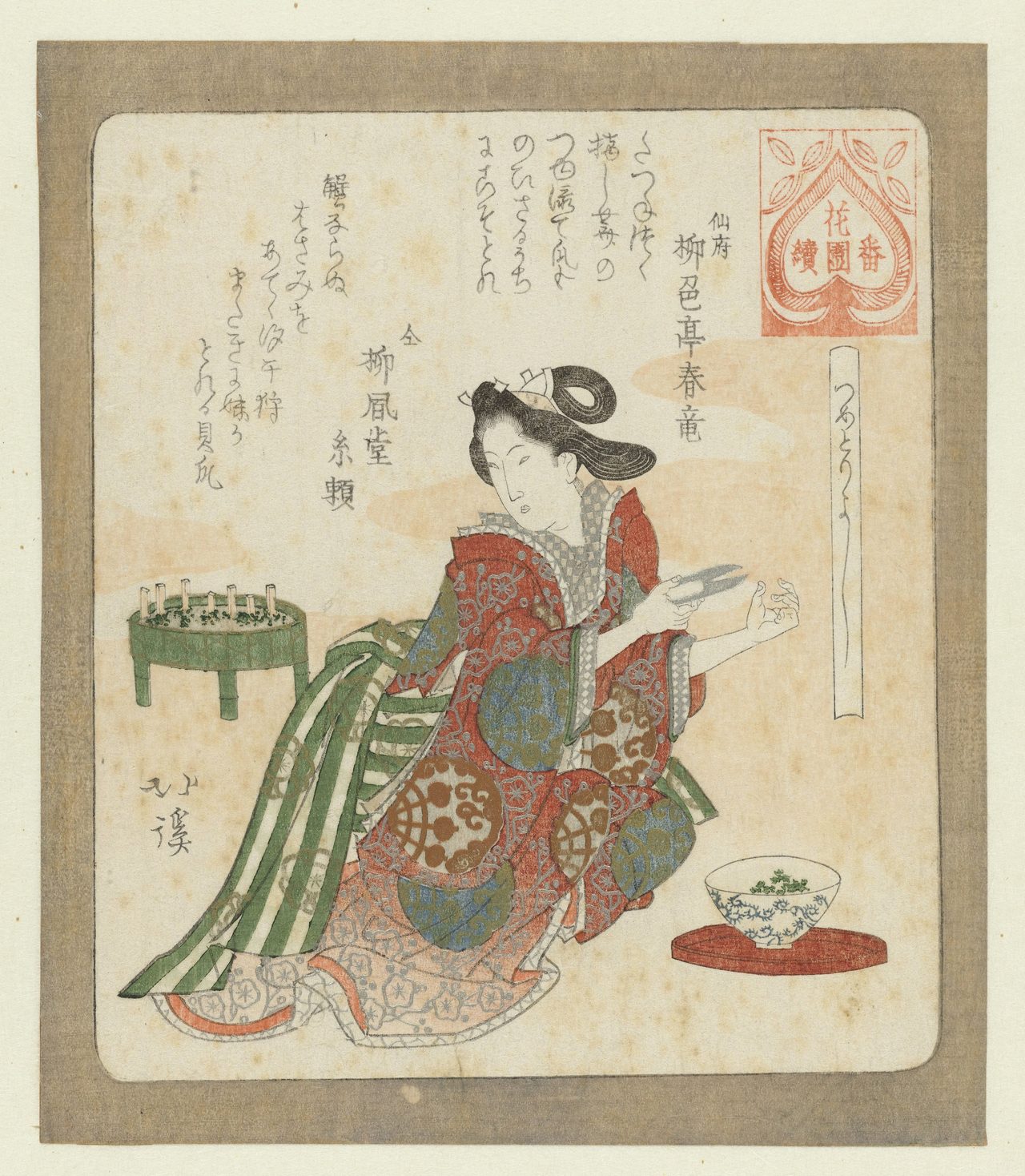
A seated woman with small scissors in her right hand, cutting her nails, a bowl of herbs on a red lacquered tray in front of her. A print by Totoya Hokkei, about 1822, titled It is good to cut your nails.
- Image:
- Totoya Hokkei, It is good to cut your nails, a woman with small scissors, colour woodcut (surimono), c. 1822. Rijksmuseum, RP-P-1958-361.
- Source:
- Han Feizi, ch. 30, our translation
In the sources below nails are cut with scissors, a nail-cutter or the teeth, and cleaned with a little knife; a barber does it, or slave boys, or a junior attendant. The texts spend more of their words on the clipping afterwards: buried, burnt, sunk in the River, consecrated to a bird. On 26 July 1881 two men in Cincinnati patented a trimmer closed by a lever. What Egypt, China, India, Zoroastrian Iran, Babylonia, the Islamic world, Greece, Rome and Japan did about nails, with the original beside our English wherever we quote.
Egypt: the overseers of the manicurists of the Great House
Under King Niuserre, in Egypt’s Fifth Dynasty, two men, Niankhkhnum and Khnumhotep, both held the title “overseer of the manicurists of the Great House”. Their tomb at Saqqara is one of the largest and most richly decorated there, and one of its scenes shows barbers, manicurists and pedicurists at work (after Egypt’s Ministry of Tourism and Antiquities, whose page gives Niuserre’s reign as c. 2445 to 2421 BC). The tomb’s publication, by A. M. Moussa and H. Altenmüller (Mainz, 1977), was not read.
China: clippings as part of the body
The Yili, the Book of Etiquette and Ceremonial, sets out the funeral of an officer. After the body is washed:
“The warm washing water is thrown into the pit. The nails are trimmed as on ordinary days. The hair is tied with a cord and pinned, and the clean garments are put on. [...] The cloth, the spoon, the loose hair and the nail parings are buried in the pit.”
Yili, Shi sang li. Our translation.
渜濯棄於坎。蚤,揃如他日。鬠用組,乃笄,設明衣裳。 [...] 巾、柶、鬊、蚤埋於坎。
The pit was dug between the steps earlier in the same rite. The Liji, the Book of Rites, gives the job to a junior attendant and sorts the dead by rank:
“A junior attendant trims the toenails. The water left from the washing is thrown into the pit. [...] A junior attendant trims the fingernails and cuts the beard. The water from the hair-washing is thrown into the pit. [...] For a ruler or a great officer, the loose hair and the nail clippings are put into the coffin; for an ordinary officer, they are buried.”
Liji, Sang da ji. Our translation.
小臣爪足。浴餘水棄于坎。 [...] 小臣爪手翦須。濡濯棄于坎。 [...] 君、大夫鬊爪實于緑中,士埋之。
Two stories put cut nails into a prayer. Sima Qian’s Shiji tells this of the Duke of Zhou, whose own name was Dan:
“Earlier, when King Cheng was young, he fell ill. The Duke of Zhou then cut his own nails and sank them in the River, and prayed to the spirits, saying: ‘The king is young and does not yet understand. The one who offended against the spirits’ commands is I, Dan.’ He also stored the written prayer in the archive. King Cheng’s illness eased.”
Sima Qian, Shiji, ch. 33, Lu Zhou gong shijia. Our translation.
初,成王少時,病,周公乃自揃其蚤沈之河,以祝於神曰:『王少未有識,奸神命者乃旦也。』亦藏其策於府。成王病有瘳。
The character the Shiji uses for the nails, 蚤, stands for 爪, nail: the Qing encyclopedia Gujin tushu jicheng quotes the same line with 爪. The same encyclopedia quotes the Diwang shiji on King Tang:
“In Tang’s time there was a great drought. The Yin scribe said: ‘The divination says a man should be offered in prayer.’ Tang said: ‘What I mean is that I myself should be the one.’ So he fasted and purified himself, cut his hair and cut off his nails, made himself the sacrificial victim, and prayed in the open country of the Mulberry Grove, announcing it to High Heaven. Soon a great rain came.”
The Diwang shiji, as quoted in the Gujin tushu jicheng, Renshi dian, juan 18. Our translation.
湯時大旱,殷史曰:「『卜當以人禱』。湯曰:『吾所謂自當』。」遂齋戒剪髮斷爪,己為牲,禱于桑林之野,告于上天,已而雨大至。
In the Huainanzi, a general who has just been handed the axes by his ruler gets ready:
“Then he trims his nails and hair, puts on the clean garments, cuts an ill-omened gate and goes out. He rides the general’s chariot, carrying the banners and the axes, weighed down as if he could not bear them. When he meets the enemy and fights the decisive battle, he does not look back, resolved to die, and has no divided heart.”
Huainanzi, ch. 15, Bing lüe. Our translation.
乃爪鬋,設明衣也,鑿凶門而出。乘將軍車,載旌旗斧鉞,累若不勝。其臨敵決戰,不顧必死,無有二心。
Trimmed nails and clean garments are two of the things the Yili does for a corpse. The comparison is ours; neither text draws it.
And the Han Feizi has a ruler who uses a clipping to test his court. The story illustrates the sixth of seven techniques, asking about what you already know:
“Marquis Zhao of Han was holding a nail clipping in his fist and pretended to have lost one. He searched for it very urgently, so those around him cut off their own nails and presented them. By this Zhao examined whether those around him were honest or not.”
Han Feizi, ch. 30, Nei chu shuo shang qi shu. Our translation.
韓昭侯握爪,而佯亡一爪,求之甚急,左右因割其爪而效之。昭侯以此察左右之誠不。
He had the clipping in his fist, so anyone who handed him one was handing him their own.
Long nails are in the record too, as one person’s mark. The same encyclopedia quotes the Chen shu on an empress:
“When young, the empress was bright and clever, with a fine face and bearing. Her fingernails were five cun long, both red and white in colour. Whenever she was to wear mourning of the one-year, nine-month or five-month grades, one nail would break first.”
Chen shu, biography of Empress Zhang, as quoted in the Gujin tushu jicheng, Renshi dian, juan 18. Our translation.
《陳書高祖宣皇后章氏傳》:「后少聰慧,美容儀,手爪長五寸,色並紅白。每有期功之服,則一爪先折。」
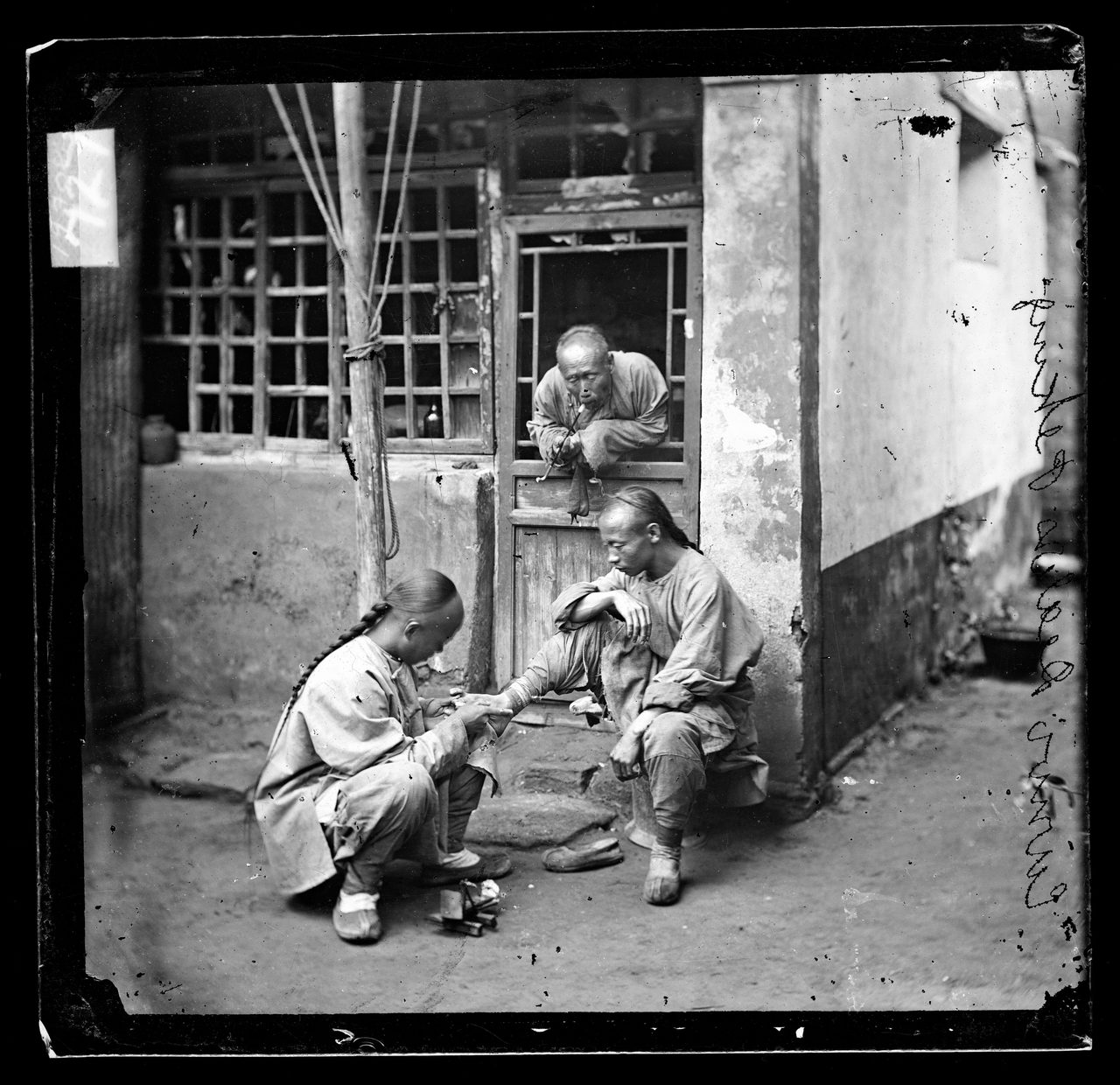
A travelling chiropodist in Peking, photographed by John Thomson in 1869. Wellcome’s record describes him “operating on a painful corn and dressing the toe-nails of his patient”. The negative’s own label reads Curio-dealers; Wellcome follows the legend Thomson published in 1873 to 1874.
- Image:
- John Thomson, a travelling chiropodist at work in Peking, photograph, 1869. Wellcome Collection. Public Domain Mark.
- Source:
- Yili, Shi sang li; Sima Qian, Shiji, ch. 33. Our translations
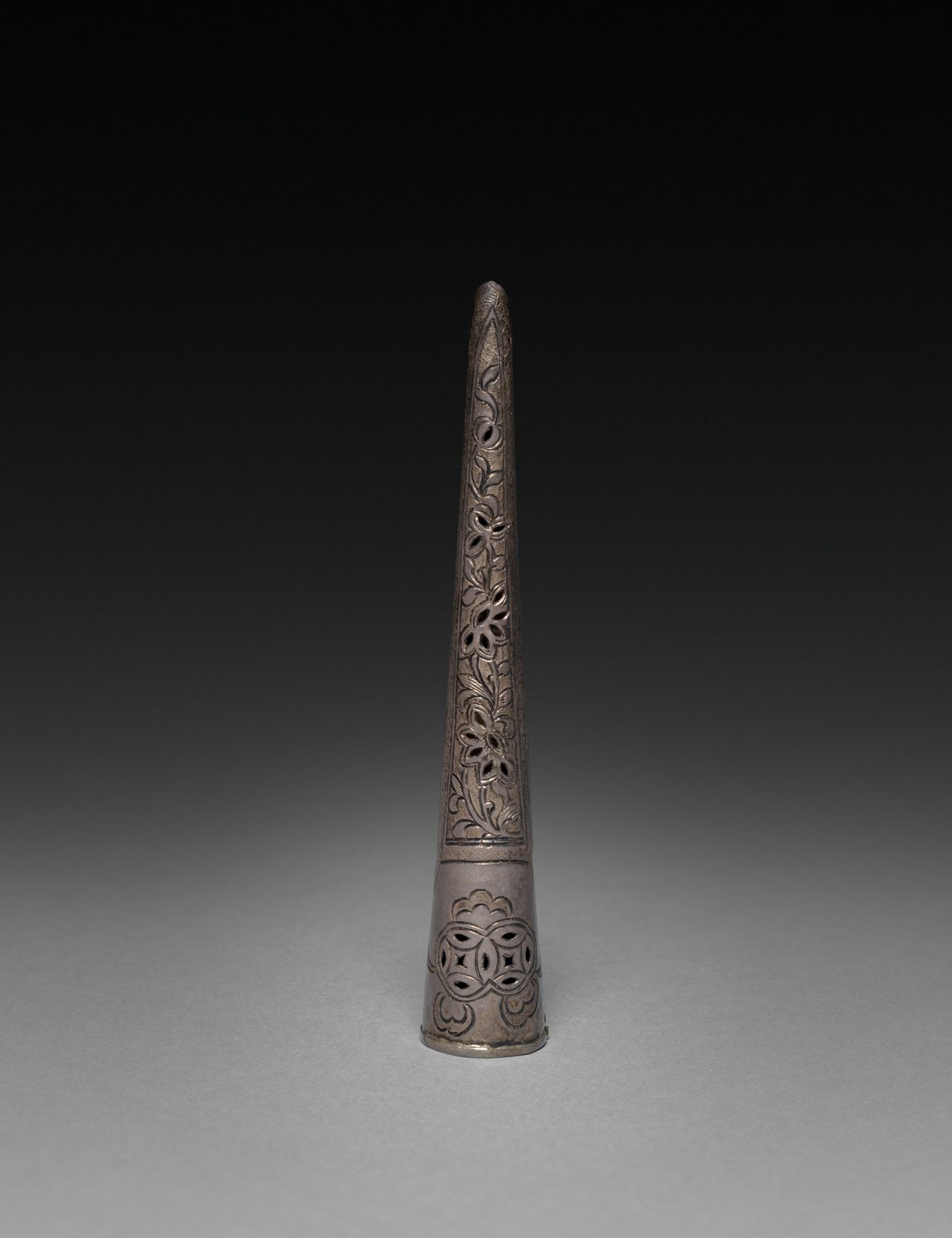
A fingernail protector, metal, 9.6 cm, China, early 1900s. A nail guard of the early 1900s, not an object of the Zhou or the Han.
- Image:
- Fingernail protector, metal, China, early 1900s. The Cleveland Museum of Art, 1916.426.
- Source:
- Han Feizi, ch. 30, Nei chu shuo shang qi shu, our translation
The guards that protect such nails are late. David R. Daly of the National Park Service writes: “Fingernail guards were worn by high ranking Chinese women during the latter half of the 19th century”.
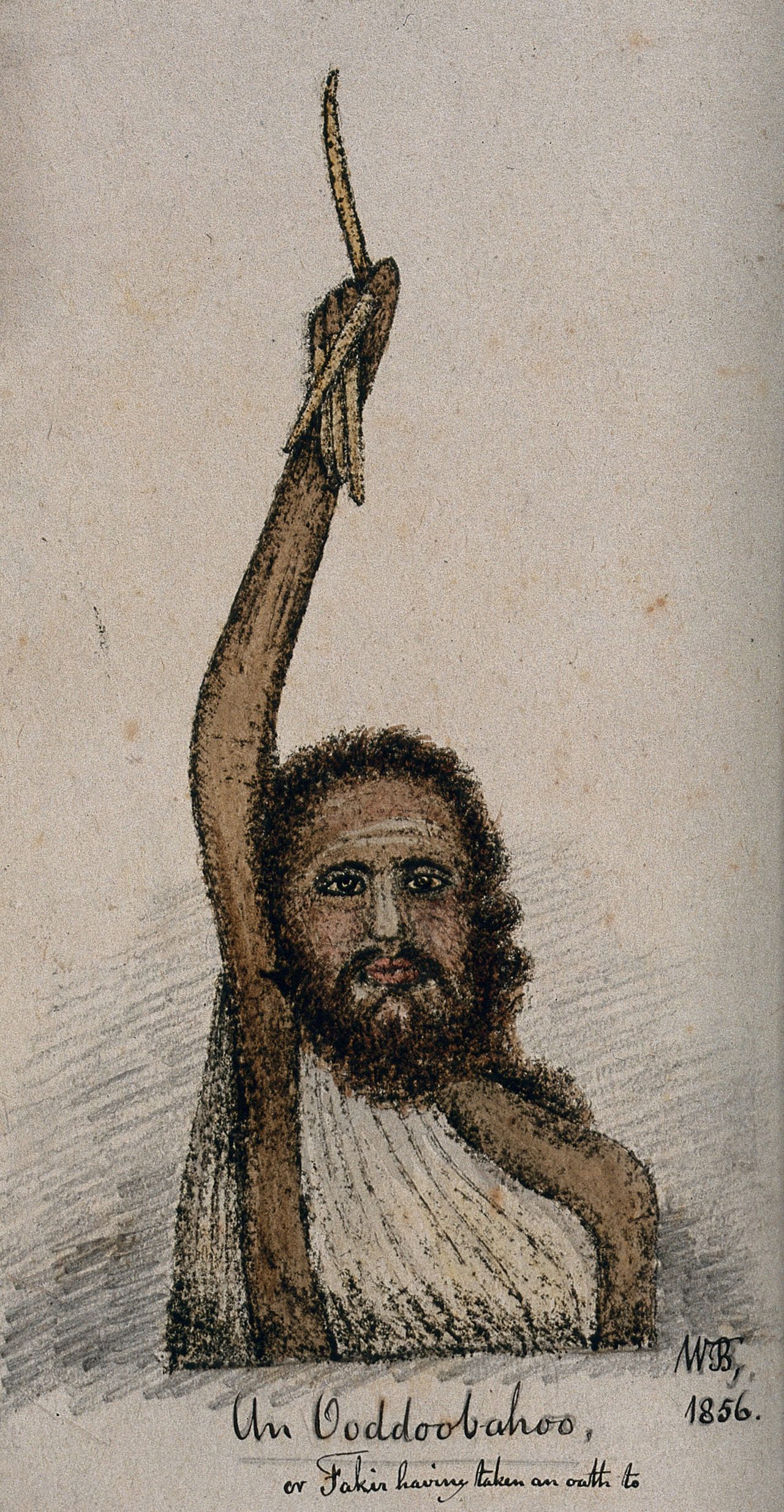
A sadhu with very long fingernails holding his arm above his head, an ink and watercolour drawing signed WB, 1856. Wellcome’s record gives the lettering as “An Ouddoobahoo, or fakir having taken his oath to [...]”. An ascetic’s vow, the opposite of the monks’ rule.
- Image:
- WB, a sadhu with very long fingernails holding his arm above his head, ink and watercolour drawing, India, 1856. Wellcome Collection. Public Domain Mark.
- Source:
- Vinaya Pitaka, Cullavagga V.27, tr. T. W. Rhys Davids and Hermann Oldenberg (1885)
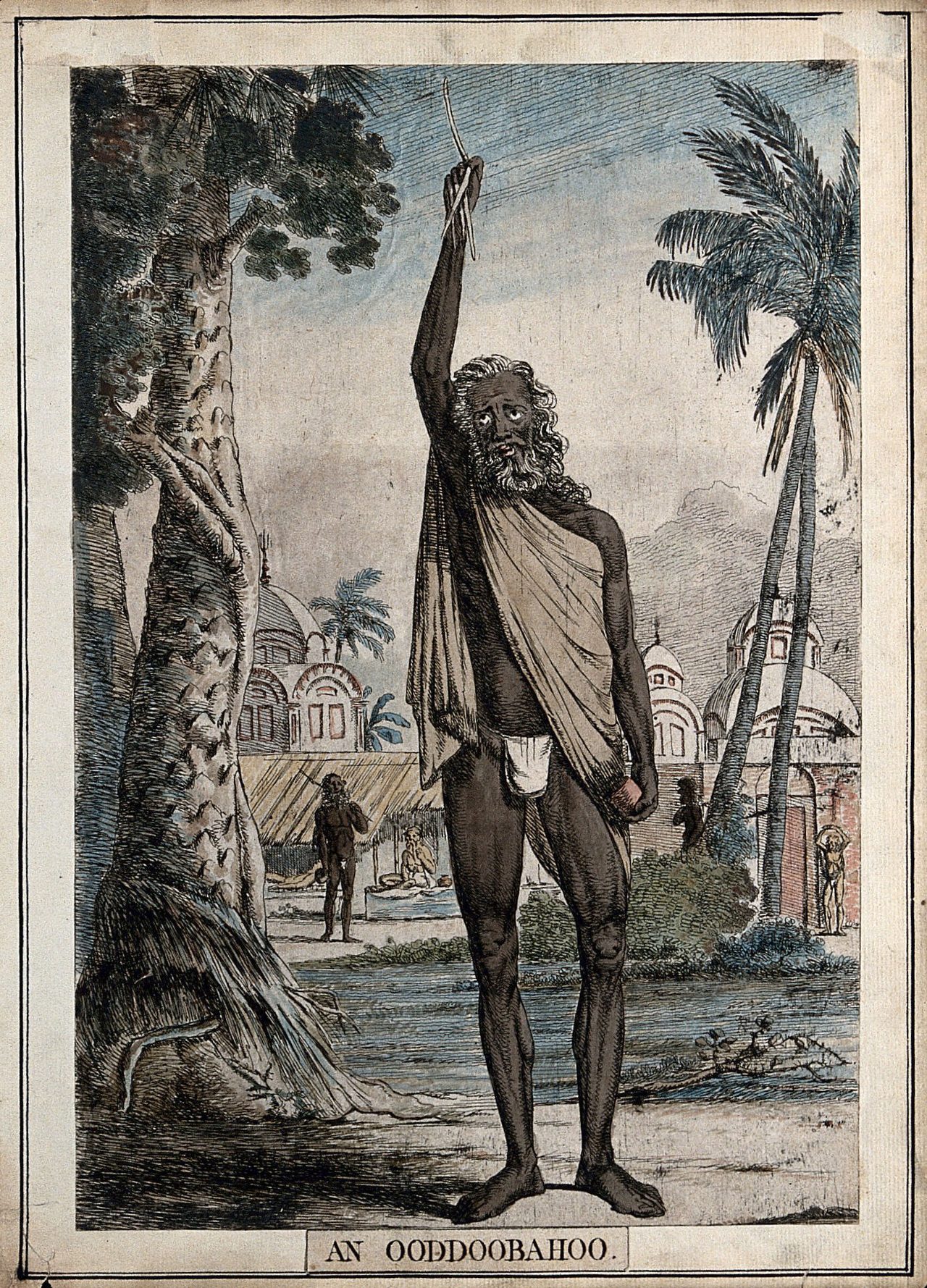
A sadhu with raised arm and overgrown fingernails, a coloured etching by François Balthazar Solvyns, Calcutta, 1799, lettered AN OODDOOBAHOO. Made 132 years after Bernier’s letter.
- Image:
- François Balthazar Solvyns, a sadhu with raised arm and overgrown fingernails, Calcutta, coloured etching, 1799. Wellcome Collection. Public Domain Mark.
- Source:
- François Bernier, Travels in the Mogul Empire, tr. Irving Brock, revised by Archibald Constable (1891), p. 316
India: the Buddha allows a nail-cutter
The Vinaya, the monks’ rule, in the translation of T. W. Rhys Davids and Hermann Oldenberg (1885), begins with a ban: “You are not, O Bhikkhus, to wear long nails.” What follows is a rule being worked out. “Now at that time the Bhikkhus tore off their nails with the nails, bit them off with their teeth, or rubbed them down against the wall; and their fingers were hurt.” Then: “‘I allow you, O Bhikkhus, nail-cutters.’ They cut their nails down to the blood, and their fingers were hurt. ‘I allow you, O Bhikkhus, to cut your nails according to the length of the flesh.’” The Pali for nail-cutters is nakhacchedana. Polish is out: “You are not, O Bhikkhus, to have the twenty nails polished. I allow you, O Bhikkhus, to remove the dirt only.”
The Laws of Manu, in Georg Bühler’s translation (1886), tell the graduate to live “Keeping his hair, nails, and beard clipped” (4.35), and later in the same chapter say “Let him not clip his nails or hair, and not tear his nails with his teeth” (4.69), without saying how the two fit. A man who “bites his nails, goes soon to perdition” (4.71).
François Bernier’s letter to Chapelain, dated Shiraz, 4 October 1667, describes ascetics with an arm “perpetually lifted up above the head; the nails of their hands being twisted, and longer than half my little finger, with which I measured them” (tr. Irving Brock, revised by Archibald Constable, 1891, p. 316). The pages around the line are hostile, and we quote the measurement only.
Zoroastrian Iran: bury them, or arm the demons
The Vendidad, in James Darmesteter’s translation (1898), gives the rite: “For the nails, thou shalt dig a hole, out of the house, as deep as the top joint of the little finger”. Then: “thou shalt draw three furrows with a knife of metal around the hole, or six furrows or nine”. The nails are offered to a bird, the Asho-zushta: “these nails I announce and consecrate unto thee. May they be for thee so many spears and knives, so many bows and falcon-winged arrows and so many sling-stones against the Mazainya Daevas”. Unconsecrated, they arm the other side: “If those nails have not been consecrated (to the bird), they shall be in the hands of the Mazainya Daevas so many spears and knives so many bows and falcon-winged arrows, and so many sling-stones”.
Darmesteter’s notes name the bird: “‘The owl,’ according to modern tradition.” He quotes the Bundahishn: “when the nails have had a spell uttered over them, the bird takes and eats them up, that the fiends may not do any harm by their means”. And he adds how it is done: “The nails are cut in two and the fragments are put in the hole with the point directed towards the north, that is to say, against the breasts of the Devs”.
The Sad Dar, in E. W. West’s translation (1885), gives its own steps. The parings go “into a paper”; a man who does not know the Baj is “to furrow three lines, with the nail-cutter, around the nail-parings”; and “he should carry a hole down through four finger-breadths of earth, and, having placed the nail-parings in that spot, he puts the soil overhead.” Of the bird: “They also call it the owl, and it eats nails.” The parings must be broken, “for they would come into use as weapons (sila’h) of wizards”, and “if they fall in the midst of food, there is danger of pulmonary consumption.” West says only that the Sad Dar “had the reputation of being a very old work in the early part of the sixteenth century”. We print no date for the Vendidad.
Babylonia: righteous, pious, wicked
The Babylonian Talmud, in tractate Moed Katan, gives a ruling of Rav’s against scissors, said of a mourner, and then what Rav Shemen bar Abba saw:
“Rav Hiyya bar Ashi said in the name of Rav: And with scissors it is forbidden. Rav Shemen bar Abba said: I was standing before Rabbi Yohanan in the study hall on the intermediate days of a festival, and he cut his nails with his teeth and threw them away. Learn three things from this: that it is permitted to cut nails on the intermediate days of a festival; that there is nothing repulsive in them; and that it is permitted to throw them away. [...] A woman is not often found in the study hall.”
Babylonian Talmud, Moed Katan 18a. Our translation.
אמר רב חייא בר אשי אמר רב ובגנוסטרא אסור אמר רב שמן בר אבא הוה קאימנא קמיה דר' יוחנן בי מדרשא בחולו של מועד ושקלינהו לטופריה בשיניה וזרקינהו / שמע מינה תלת שמע מינה מותר ליטול צפרנים בחולו של מועד ושמע מינה אין בהן משום מיאוס ושמע מינה מותר לזורקן [...] אשה בי מדרשא לא שכיחא
Between the three lessons and the last line comes an objection:
“Is that so? Was it not taught: Three things were said about nails. One who buries them is righteous; one who burns them is pious; one who throws them away is wicked. What is the reason? Lest a pregnant woman pass over them and miscarry.”
Babylonian Talmud, Moed Katan 18a. Our translation.
איני והתניא שלשה דברים נאמרו בצפרנים הקוברן צדיק שורפן חסיד זורקן רשע טעמא מאי שמא תעבור עליהן אשה עוברה ותפיל
The line about the study hall is the answer to it. The passage on mourners’ nails opens with two brothers:
“A bereavement befell Pinehas, the brother of Mar Shmuel. Shmuel went in to ask him about it, and saw that his nails were long. He said to him: Why have you not cut them? He said to him: If it had happened to you, would you treat it so lightly? It was ‘like an error that goes out from before the ruler’ (Ecclesiastes 10:5): a bereavement befell Shmuel. Pinehas his brother went in to ask him about it. Shmuel cut his own nails and flung them in Pinehas’s face, and said to him: Do you not hold that a covenant is made with the lips?”
Babylonian Talmud, Moed Katan 18a. Our translation.
פנחס אחוה דמר שמואל איתרע ביה מילתא על שמואל למישאל טעמא מיניה חזנהו לטופרי דהוו נפישן אמר ליה אמאי לא שקלת להו אמר ליה אי בדידיה הוה מי מזלזלת ביה כולי האי / הואי (קהלת י, ה) כשגגה שיוצא מלפני השליט ואיתרע ביה מילתא בשמואל על פנחס אחוה למישאל טעמא מיניה שקלינהו לטופריה חבטינהו לאפיה אמר ליה לית לך ברית כרותה לשפתים
It is Shmuel who flings his own nails, and he says why: his brother’s earlier remark about a loss of Shmuel’s own had come true.
Tractate Niddah puts thrown nails on a list:
“Rabbi Shimon bar Yohai said: There are five things that put the life of whoever does them at risk, and his blood is on his own head: one who eats peeled garlic, a peeled onion or a peeled egg; one who drinks diluted drinks that have stood overnight; one who spends the night in a graveyard; one who cuts his nails and throws them into a public place; and one who lets blood and then lies with his wife. [...] One who cuts his nails and throws them into a public place: because a pregnant woman passes over them and miscarries. And we said this only when he cut them with scissors; and only when he cut those of his hands and of his feet; and only when he cut nothing after them, but if he cut something after them, we have no concern. But that is not so: we are concerned about all of it.”
Babylonian Talmud, Niddah 17a. Our translation.
אמר ר"ש בן יוחי ה' דברים הן שהעושה אותן מתחייב בנפשו ודמו בראשו האוכל שום קלוף ובצל קלוף וביצה קלופה והשותה משקין מזוגין שעבר עליהן הלילה והלן בבית הקברות והנוטל צפרניו וזורקן לרה"ר והמקיז דם ומשמש מטתו [...] והנוטל צפרניו וזורקן לרשות הרבים מפני שאשה מעוברת עוברת עליהן ומפלת ולא אמרן אלא דשקיל בגנוסטרי ולא אמרן אלא דשקיל דידיה ודכרעיה ולא אמרן אלא דלא גז מידי בתרייהו אבל גז מידי בתרייהו לית לן בה ולא היא לכולה מילתא חיישינן
The three limits are set and then rejected: none of them stands.
One verse of Deuteronomy says only that a woman shall “do her nails”. The rabbis split on what that means:
“The Sages taught: ‘And she shall shave her head and do her nails’ (Deuteronomy 21:12). Rabbi Eliezer says: she is to cut them. Rabbi Akiva says: she is to let them grow. Rabbi Eliezer said: ‘doing’ is said of the head and ‘doing’ is said of the nails; just as there it means removing, so here it means removing. Rabbi Akiva says: ‘doing’ is said of the head and ‘doing’ is said of the nails; just as there it means disfiguring, so here it means disfiguring.”
Babylonian Talmud, Yevamot 48a. Our translation.
תנו רבנן (דברים כא, יב) וגלחה את ראשה ועשתה את צפרניה רבי אליעזר אומר תקוץ רבי עקיבא אומר תגדיל / אמר רבי אליעזר נאמרה עשיה בראש ונאמרה עשיה בצפרנים מה להלן העברה אף כאן העברה רבי עקיבא אומר נאמר עשיה בראש ונאמר עשיה בצפרנים מה להלן ניוול אף כאן ניוול
Rashi follows Rabbi Akiva:
“‘And she shall do her nails’: she shall let them grow, so that she becomes unattractive. (Sifrei; Yevamot 48)”
Rashi on Deuteronomy 21:12. Our translation.
ועשתה את צפרניה. תְּגַדְּלֵם כְּדֵי שֶׁתִּתְנַוֵּל (ספרי; יבמות מ"ח):
The Islamic world: never more than forty nights
Sahih al-Bukhari gives these words of the Prophet Muhammad:
“From Abu Hurayra (may God be pleased with him): I heard the Prophet (God bless him and grant him peace) say: ‘The fitra is five things: circumcision, shaving the pubic hair, trimming the moustache, clipping the nails and plucking the armpits.’”
Sahih al-Bukhari 5891. Our translation.
عَنْ أَبِي هُرَيْرَةَ ـ رضى الله عنه ـ سَمِعْتُ النَّبِيَّ صلى الله عليه وسلم يَقُولُ "الْفِطْرَةُ خَمْسٌ الْخِتَانُ، وَالاِسْتِحْدَادُ، وَقَصُّ الشَّارِبِ، وَتَقْلِيمُ الأَظْفَارِ، وَنَتْفُ الآبَاطِ ".
Fitra is the natural or original way of things. Sahih Muslim adds an interval:
“From Anas ibn Malik: Anas said: A time limit was set for us for trimming the moustache, clipping the nails, plucking the armpits and shaving the pubic hair: that we not leave them for more than forty nights.”
Sahih Muslim 258. Our translation.
عَنْ أَنَسِ بْنِ مَالِكٍ، قَالَ قَالَ أَنَسٌ وُقِّتَ لَنَا فِي قَصِّ الشَّارِبِ وَتَقْلِيمِ الأَظْفَارِ وَنَتْفِ الإِبْطِ وَحَلْقِ الْعَانَةِ أَنْ لاَ نَتْرُكَ أَكْثَرَ مِنْ أَرْبَعِينَ لَيْلَةً .
The hadith does not name who set the limit.
Greece and Rome: an iron rule, a miser and slaves who sang
Hesiod puts it as a riddle: “μηδ᾽ ἀπὸ πεντόζοιο θεῶν ἐν δαιτὶ θαλείῃ / αὖον ἀπὸ χλωροῦ τάμνειν αἴθωνι σιδήρῳ”, “At a cheerful festival of the gods do not cut the withered from the quick upon that which has five branches with bright steel.” (Works and Days 742 to 743, tr. Hugh G. Evelyn-White, 1914). His note solves it: “I.e. ‘do not cut your finger-nails.’” The Greek word is iron; “bright steel” is Evelyn-White’s.
Plautus’s Aulularia has a joke about the miser Euclio: “quin ipsi pridem tonsor unguis dempserat: / collegit, omnia abstulit praesegmina”, “the barber had cut his nails; he collected all the parings, and carried them off” (lines 312 to 313, tr. Henry Thomas Riley, 1852).
Horace describes a man, Volteius Mena, a crier:
“a certain close-shaven man in the empty shade of a barber’s booth, gently cleaning his own nails with a little knife”
Horace, Epistles 1.7.50 to 51. Our translation.
adrasum quendam uacua tonsoris in umbra / cultello proprios purgantem leniter unguis.
He is alone in the booth, cleaning his own nails. No barber is at work in the lines.
The dinner Petronius invents for Trimalchio is satire, not a record of what Roman hosts did:
“So at last we took our places at table, while Alexandrian slave boys poured snow-cooled water over our hands, and others came after them to our feet and took off our hangnails with great precision. And not even at so tiresome a task did they keep quiet: they sang as they worked.”
Petronius, Satyricon 31. Our translation.
Tandem ergo discubuimus, pueris Alexandrinis aquam in manus nivatam infundentibus, aliisque insequentibus ad pedes ac paronychia cum ingenti subtilitate tollentibus. Ac ne in hoc quidem tam molesto tacebant officio, sed obiter cantabant.
Later in the same novel a sailor named Hesus states a belief of the sea, after the heroes have had their heads shaved on board at night:
“For I hear that no mortal is allowed to remove either nails or hair on a ship, except when the wind is angry with the sea.”
Petronius, Satyricon 104. Our translation.
Audio enim non licere cuiquam mortalium in nave neque ungues neque capillos deponere, nisi cum pelago ventus irascitur
Pliny the Elder records a scruple about market days:
“By the belief of many, it is a matter of religious scruple to have one’s nails cut on Roman market days in silence, beginning with the forefinger.”
Pliny the Elder, Natural History 28.28, ed. Mayhoff. Our translation.
ungues resecari nundinis Romanis tacenti atque a digito indice multorum persuasione religiosum est
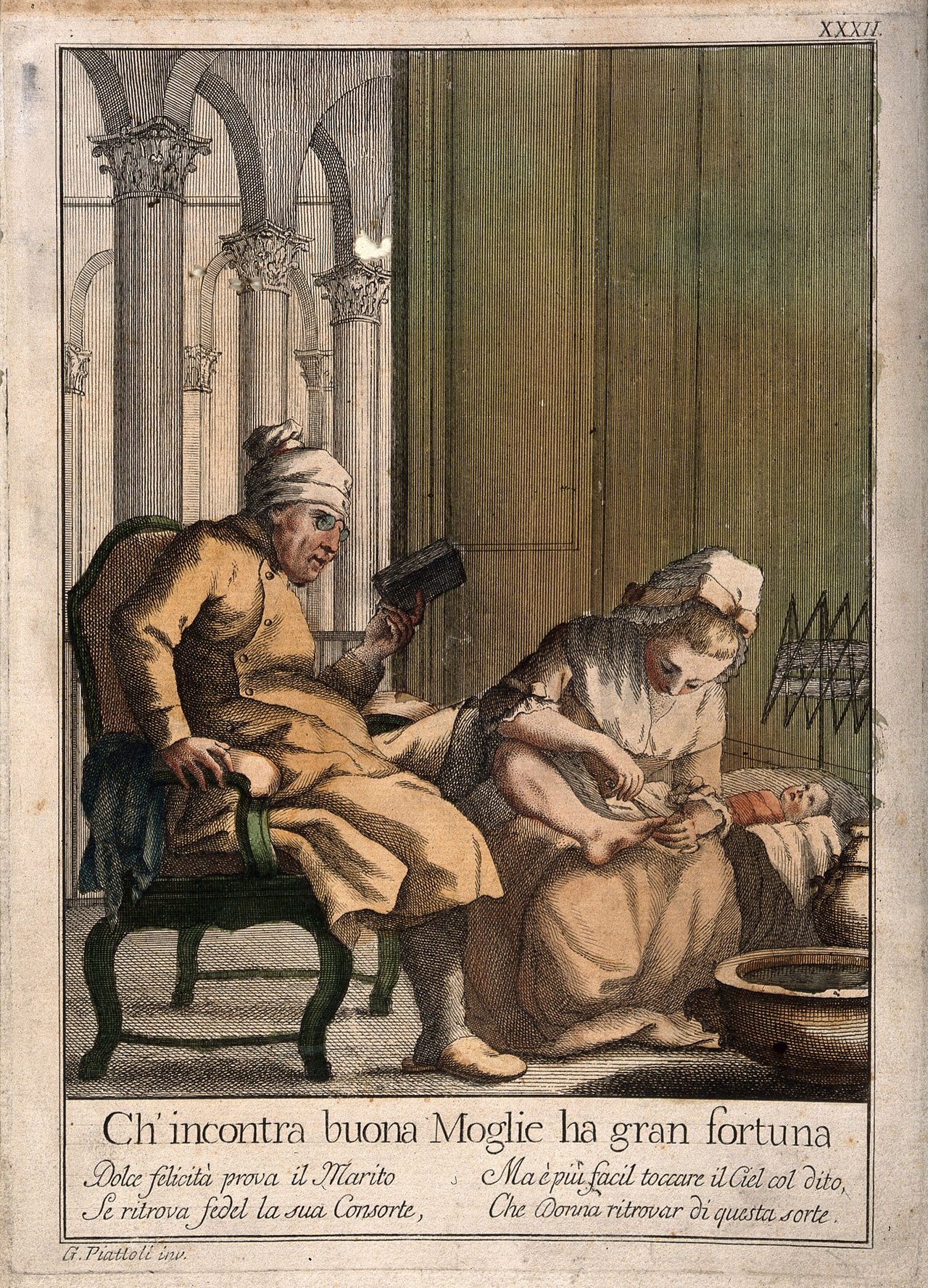
A man reads a book while his wife cuts his toenails, a baby in a cradle beside her. An Italian print after Giuseppe Piattoli, about 1800. Not Roman: we found no open Roman image of nail care.
- Image:
- After Giuseppe Piattoli, a man reads a book while his wife cuts his toenails, coloured etching, Italy, about 1800. Wellcome Collection. Public Domain Mark.
- Source:
- Plautus, Aulularia 312 to 313, tr. H. T. Riley (1852); Petronius, Satyricon 31, our translation
Whether this touched money rests on a disputed word. The manuscripts have pecuniae, of money; Mayhoff’s edition, which we follow, prints his own conjecture, persuasione, by the belief. John Bostock and H. T. Riley (1855 to 1857) translated the manuscripts’ word: “It is religiously believed by many, that it is ominous in a pecuniary point of view, for a person to pare his nails without speaking, on the market days at Rome, or to begin at the forefinger”. The Latin does not say whether the custom was lucky, unlucky or required.
Japan: a god’s punishment, and the seven-herb nail cut
In the Kojiki, in Basil Hall Chamberlain’s translation (1882), a god’s punishment begins with a fine of “a thousand tables” and goes on: “and likewise cut his beard, and even caused the nails of his fingers and toes to be pulled out, and expelled him”. The nails are part of the punishment, listed beside the fine.
The seven-herb nail cut belongs to the seventh day of the New Year. A Japanese dictionary explains nanakusa-zume, seven-herb nails: at the seven-herb festival on the seventh day of the first month, people dipped their fingers in water in which the seven herbs had been boiled, and then cut their nails, to drive off evil. Its earliest example is a senryū of 1794 (after the Seisenban Nihon Kokugo Daijiten). The dictionary also quotes Kurokawa Dōyū’s Hinami kiji, known in a manuscript of 1676 and a printed edition with a preface of 1685:
“The seven herbs [...] Among ordinary people, they soak their nails in the hot water in which the seven herbs were scalded, and cut them.”
Kurokawa Dōyū, Hinami kiji, the seventh day of the first month, as quoted in the Seisenban Nihon Kokugo Daijiten. Our translation.
七草〈略〉俗間以燖七草之湯漬爪剪之
One character of that line is printed in the dictionary only as a small image, which we read as 燖, to scald.
Totoya Hokkei’s print at the head of this page is titled Tsumetoriyoshi, in the Rijksmuseum’s Dutch “Het is goed om je nagels te knippen”, “It is good to cut your nails.” The museum describes it:
“A seated woman with small scissors in her right hand, cutting her nails. In front of her, a bowl of herbs on a red lacquered tray on the floor. With two poems. The prints in this series tie in with the belief that the first activities of the new year were especially significant. The red cartouche on the prints refers to almanacs that set out which activities people born in a given year could, or had better not, undertake on certain days.”
Rijksmuseum, record of RP-P-1958-361. Our translation.
Een zittende vrouw met schaartje in de rechterhand, haar nagels knippend. Voor haar een kom met kruiden op een rood gelakt dienblad op de grond. Met twee gedichten. De prenten uit deze serie sluiten aan op het geloof dat de eerste activiteiten van het nieuwe jaar extra bijzonder waren. Het rode cartouche op de prenten verwijst naar almanakken waarin werd aangegeven welke activiteiten wel of beter niet op bepaalde dagen ondernomen konden worden door mensen geboren in een bepaald jaar.
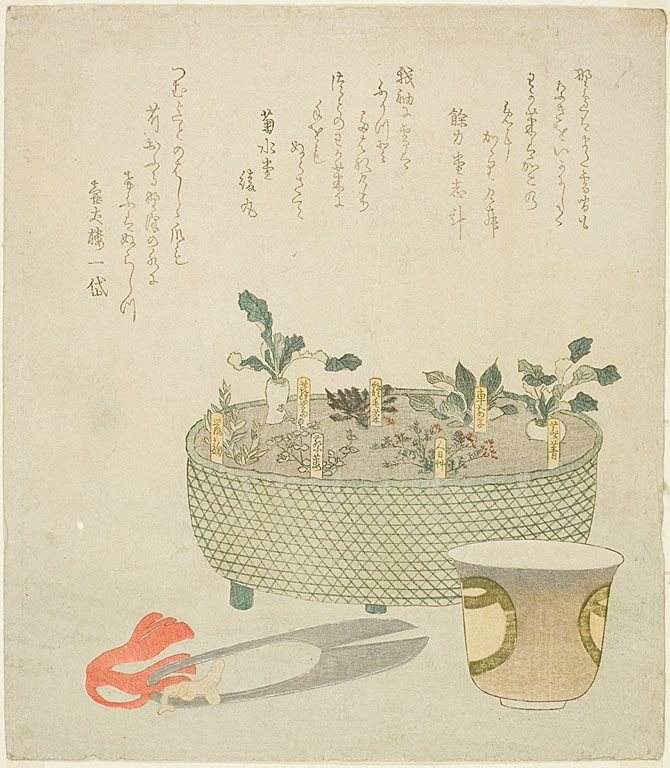
The Seven Herbs (Nanakusa), with Scissors and Teacup, a print by Teisai Hokuba, 19th century: a basket of herbs with name tags, spring scissors with a red cord, a cup. Only the title names the seven herbs, and the record gives no year.
- Image:
- Teisai Hokuba, The Seven Herbs (Nanakusa), with Scissors and Teacup, colour woodcut (surimono), 19th century. The Art Institute of Chicago, 1954.709.
- Source:
- Kurokawa Dōyū, Hinami kiji, as quoted in the Seisenban Nihon Kokugo Daijiten, our translation
The record never names the seven herbs, so the print is probably the seven-herb cut, and no more than probably. We did not read the two poems.
The north: a ship of dead men’s nails
Snorri Sturluson’s Younger Edda, in Rasmus B. Anderson’s translation (1879): “The ship that is called Naglfar also becomes loose. It is made of the nails of dead men; wherefore it is worth warning that, when a man dies with unpared nails, he supplies a large amount of materials for the building of this ship, which both gods and men wish may be finished as late as possible.”
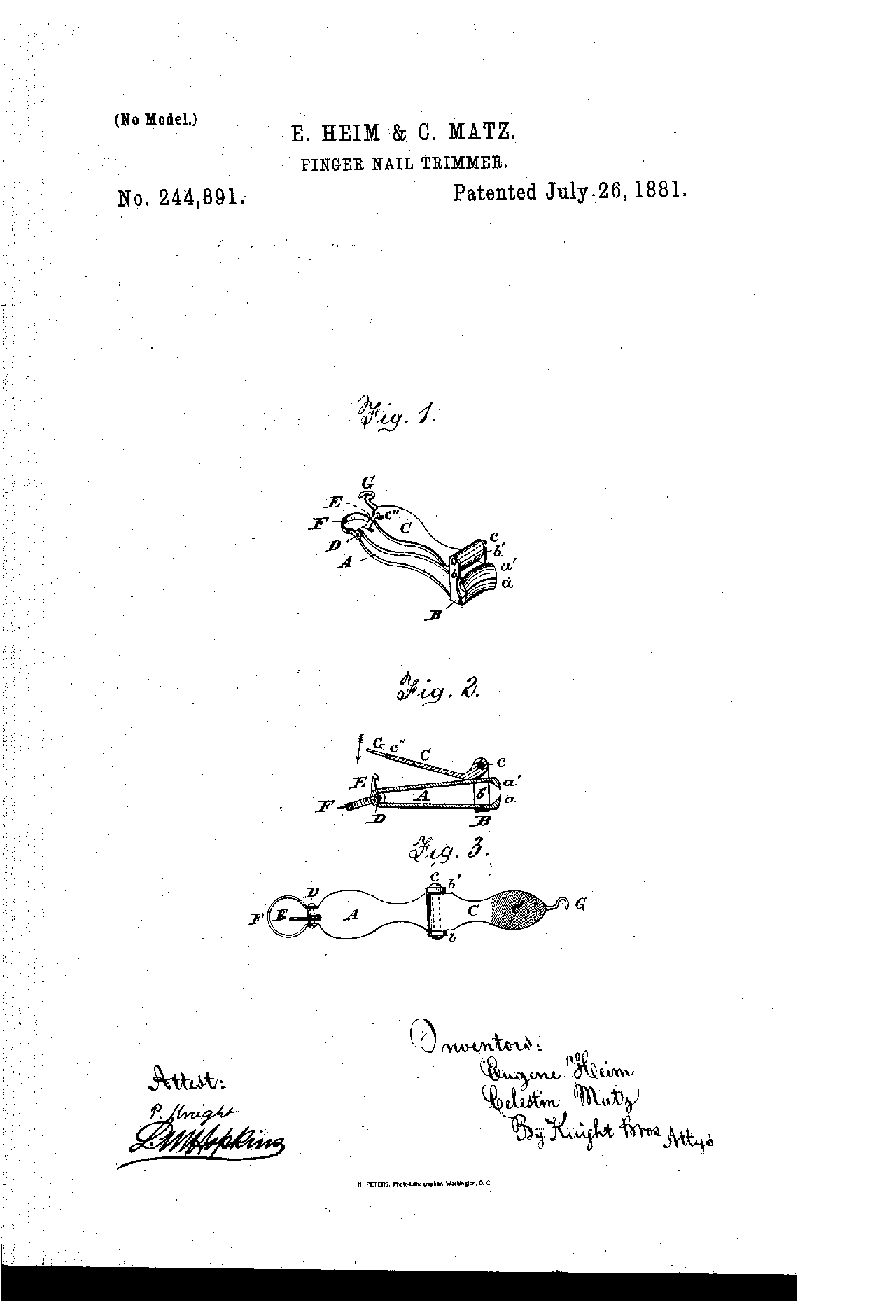
The drawing sheet of US Patent 244,891, 26 July 1881: the trimmer in perspective, from the side with its lever, and from above with the lever and the hook.
- Image:
- E. Heim and C. Matz, Finger-Nail Trimmer, US Patent 244,891, drawing, 26 July 1881. United States Patent and Trademark Office.
- Source:
- US Patent 244,891 (26 July 1881); US Patent 1,436,010 (21 November 1922)
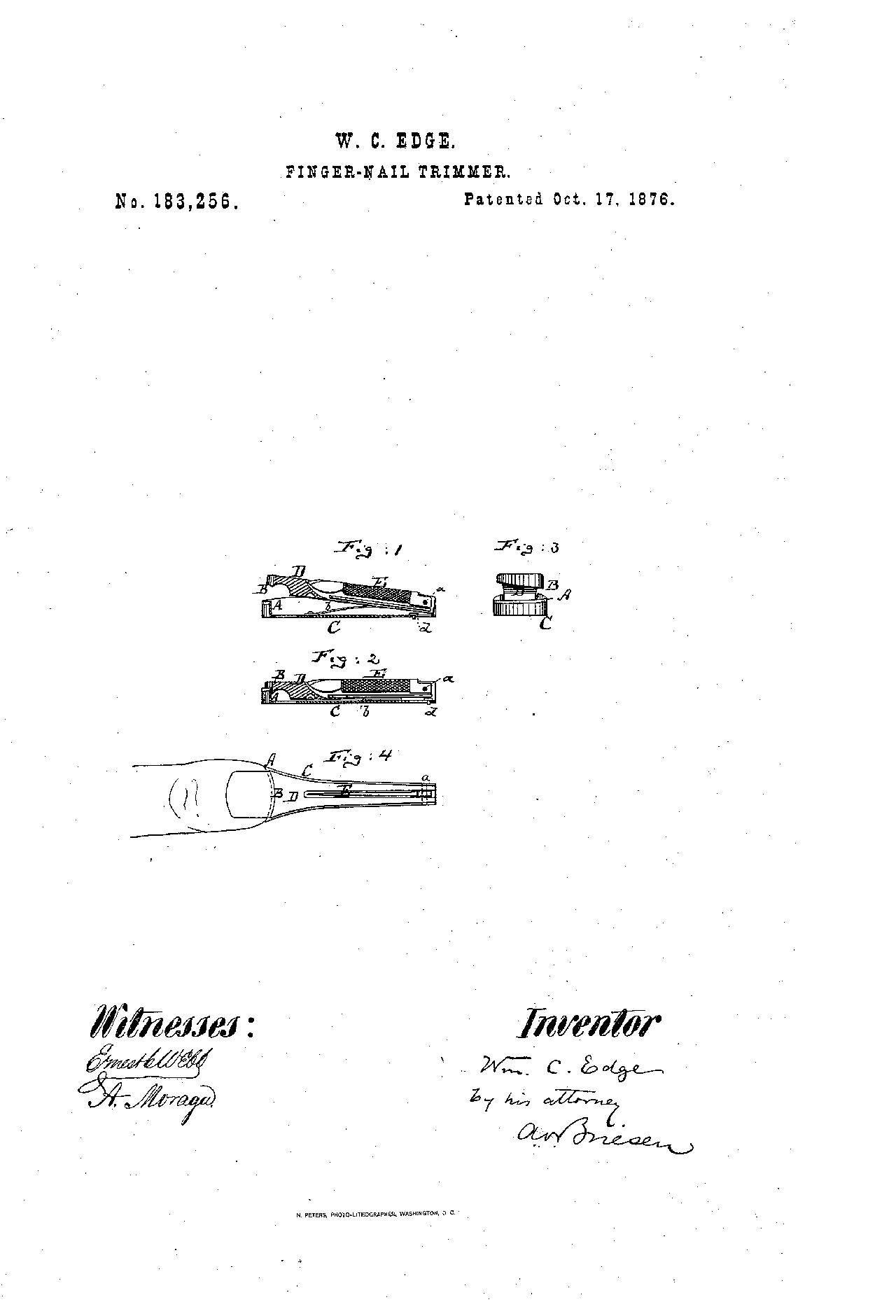
The drawing sheet of US Patent 183,256, 17 October 1876: William C. Edge’s trimmer in section, from the end and on a fingertip. A spring trimmer five years before the lever.
- Image:
- W. C. Edge, Improvement in Finger-Nail Trimmers, US Patent 183,256, drawing, 17 October 1876. United States Patent and Trademark Office.
- Source:
- US Patent 244,891 (26 July 1881); US Patent 183,256 (17 October 1876)
26 July 1881: the lever
US Patent 244,891, “Finger-Nail Trimmer”, was filed on 9 June 1881 and is dated 26 July 1881. The patentees are Eugene Heim and Celestin Matz, of Cincinnati. It describes “a pair of nipping-jaws composed of a single plate of spring-steel”, closed by “a cam-headed lever”. The lever is “roughened on its rear surface to serve as a rasp” and ends in “a hook which serves as a glove-buttoning device”, and “a bow or bail” hangs the tool from “a belt or watch-chain”.
The patent does not claim the trimmer broadly: “We are aware that finger-nail trimmers have been devised with two hinged jaws held normally gaping by a spring [...] and we therefore disclaim invention, broadly”. The words we leave out say the older jaws had “separately-attached nipping-edges” and were “compressed by the direct pressure of the operator’s thumb and finger”. The one-piece jaws and the lever are the new parts. Claim 1 covers jaws “formed of a single integral piece of steel [...] held normally gaping by their resilience, and [...] closed by a cam-headed lever”.
We read three patents from before it. Valentine Fogerty of Boston, 23 March 1875 (US 161,112): a device that trims nails “to the segment of a circle” by filing, with, in its sixth figure, “a cutter having a knife at one end and a file at the other”, and a link to wear it “on a watch-chain as an ornament”. William C. Edge of Newark, New Jersey, 17 October 1876 (US 183,256), “Improvement in Finger-Nail Trimmers”: two concave cutters, with “a suitable spring [...] interposed [...] to hold the two cutters separated, and yet allow them to be brought together”. John H. Hollman of New York, 18 June 1878 (US 205,088): a pointed blade whose slot is “beveled and sharpened to form cutting-edges”, slid into a shell to carry “in the pocket”, with a “segmental concaved file”.
What later clippers kept from 1881 is jaws closed by a cam lever, and not the single plate. A patent issued on 21 November 1922 to Chapel S. Carter and Hedley P. Carter of Ansonia, assignors to the H. C. Cook Company (US 1,436,010), has “two jaw-members” joined by “a rivet uniting the rear ends”, worked by an “operating-lever” with “lifting-cams”. Nicholson Baker, writing in The New Yorker in 1994 about William E. Bassett’s Trim clipper, put it in one line: “The jawed design had been around since the nineteenth century”. The patents of 1876 and 1881 bear him out.
The stories that don’t hold up
- “Deuteronomy 21:12 is the oldest record of nail trimming.”
The verse says only “do her nails”, and the rabbis quoted above split on whether that means cut them or let them grow. Wikipedia’s article on nail clippers dates this to the 8th century BC. Egypt’s overseers of the manicurists served under Niuserre, whose reign the Ministry’s page puts at c. 2445 to 2421 BC.
- “Horace shows a Roman barber paring his customers’ nails.”
His lines have a crier alone in an empty booth, cleaning his own nails with a little knife. The reading goes back at least to Riley’s footnote to Plautus, which says that in Horace “idlers pared their nails in the shops”. Plautus himself does have a barber cutting a customer’s nails.
- “Valentine Fogerty patented the first nail clipper in 1875.”
His patent is a filing device with a knife option, and it is dated 23 March 1875. The 24 February that Wikipedia gives is the day he filed.
- “Heim and Matz invented the nail clipper.”
Their patent says trimmers with sprung jaws already existed and disclaims “invention, broadly”, and Edge’s spring trimmer is five years older. What they patented is one-piece jaws closed by a cam-headed lever.
- “The Trim clipper dates from 1947.”
Baker, the source cited for it, writes “After the war” and gives no year.
- “Romans and Hallstatt people used nail clippers.”
Two photographs on Wikimedia Commons make the claim, and both are their uploaders’ own snapshots of museum objects: one of an object “of unknown provenance” in a Narbonne museum, the other of grave finds from the Magdalenenberg. A Roman nail tool archaeologists have studied in Britain is the nail-cleaner (N. Crummy and H. Eckardt, Archaeological Journal 160, 2003).
- “Long nails were the norm in ancient China.”
The Chen shu’s five-cun nails mark one empress, and the guards are late: worn in the latter half of the 19th century, by Daly’s account, and the one shown above is of the early 1900s. The rites above trim the nails of the dead “as on ordinary days”.
- “People pared their nails with wooden daggers.”
The line is Shakespeare’s, in Henry V: “this roaring devil i’ the old play, that every one may pare his nails with a wooden dagger”. The Boy is mocking Pistol as the stage devil of the old plays. It is a joke about the theatre.
- “Old Croghan Man shows that Iron Age people had nail tools.”
Isabella Mulhall of the National Museum of Ireland said of him in 2006: “He had very well manicured nails”. That means well-kept nails. The article names no tool.
- “Hokkei’s print shows the seven-herb nail cut.”
The Rijksmuseum’s record describes a bowl of herbs and never names the seven. Probably is as far as the record goes.
Sources
- Egypt’s Ministry of Tourism and Antiquities, the tomb of Niankhkhnum and Khnumhotep at Saqqara ; A. M. Moussa and H. Altenmüller, Das Grab des Nianchchnum und Chnumhotep (Mainz, 1977), not read.
- Yili, Shi sang li.
- Liji, Sang da ji.
- Sima Qian, Shiji, ch. 33, Lu Zhou gong shijia.
- Gujin tushu jicheng, Mingluan huibian, Renshi dian, juan 18 (the Shiji line with 爪, the Diwang shiji on King Tang, the Chen shu on Empress Zhang).
- Huainanzi, ch. 15, Bing lüe.
- Han Feizi, ch. 30, Nei chu shuo shang qi shu.
- David R. Daly, National Park Service, Longfellow House, on Chinese fingernail protectors (2 April 2019).
- Vinaya Pitaka, Cullavagga V.27.1 to 2, tr. T. W. Rhys Davids and Hermann Oldenberg (1885), Sacred Books of the East vol. 20, pp. 136 to 137 ; the Pali.
- The Laws of Manu 4.35, 4.69 and 4.71, tr. Georg Bühler (1886), Sacred Books of the East vol. 25.
- François Bernier, letter to Chapelain (Shiraz, 4 October 1667), in Travels in the Mogul Empire, A.D. 1656-1668, tr. Irving Brock, revised by Archibald Constable (Westminster, 1891), p. 316.
- Vendidad, Fargard 17.7 to 10, tr. James Darmesteter, with his notes (Sacred Books of the East, American edition, vol. 3, New York, 1898).
- Sad Dar, ch. 14, tr. E. W. West (1885), Sacred Books of the East vol. 24.
- Babylonian Talmud, Moed Katan 18a (Wikisource Talmud Bavli text on Sefaria).
- Babylonian Talmud, Niddah 17a.
- Babylonian Talmud, Yevamot 48a.
- Rashi on Deuteronomy 21:12, Hebrew text.
- Sahih al-Bukhari 5891, Arabic text.
- Sahih Muslim 258, Arabic text.
- Hesiod, Works and Days 742 to 743, tr. Hugh G. Evelyn-White (Loeb Classical Library, 1914) ; the Greek.
- Plautus, Aulularia 312 to 313 ; tr. Henry Thomas Riley (Bohn’s Classical Library, 1852), with his note on Horace.
- Horace, Epistles 1.7.50 to 56.
- Petronius, Satyricon 31 and 104.
- Pliny the Elder, Naturalis Historia 28.28, ed. Mayhoff (Perseus Digital Library Latin texts, file phi0978.phi001.perseus-lat2.xml) ; tr. John Bostock and H. T. Riley (Bohn’s Classical Library, 1855 to 1857), their book 28, ch. 5.
- Kojiki, Sect. XVII, tr. Basil Hall Chamberlain (1882), p. 70 of the text dated 1919.
- Seisenban Nihon Kokugo Daijiten (Shogakukan), entry 七種爪, with the Hinami kiji line ; the Hinami kiji in the National Diet Library’s catalogue.
- Rijksmuseum, record of RP-P-1958-361 (title and description).
- Snorri Sturluson, The Younger Edda, tr. Rasmus B. Anderson (Chicago, 1879).
- Eugene Heim and Celestin Matz, US Patent 244,891, “Finger-Nail Trimmer”, 26 July 1881.
- William C. Edge, US Patent 183,256, “Improvement in Finger-Nail Trimmers”, 17 October 1876.
- Valentine Fogerty, US Patent 161,112, 23 March 1875.
- John H. Hollman, US Patent 205,088, 18 June 1878.
- Chapel S. Carter and Hedley P. Carter, US Patent 1,436,010, 21 November 1922.
- Nicholson Baker, “Clip Art”, The New Yorker, 7 November 1994.
- William Shakespeare, Henry V, act 4, scene 4.
- James Owen, National Geographic, 17 January 2006, quoting Isabella Mulhall.
- N. Crummy and H. Eckardt, “Regional Identities and Technologies of the Self: Nail-Cleaners in Roman Britain”, Archaeological Journal 160 (2003), pp. 44 to 69, title only ; the English Wikipedia’s “Nail clipper”, read only as a pointer to the claims the myths answer ; the two Wikimedia Commons file pages behind the Roman and Hallstatt claim: File:Roman nailclipper.jpg ; File:Magdalenenberg cut and shave.jpg.


Images
- Totoya Hokkei, It is good to cut your nails, a woman with small scissors, colour woodcut (surimono), c. 1822. Rijksmuseum, RP-P-1958-361. Held by Rijksmuseum, Amsterdam, Public Domain Mark.
- John Thomson, a travelling chiropodist at work in Peking, photograph, 1869. Wellcome Collection. Public Domain Mark. Held by Wellcome Collection, London, 19708i.
- Fingernail protector, metal, China, early 1900s. The Cleveland Museum of Art, 1916.426. Held by The Cleveland Museum of Art, CC0.
- WB, a sadhu with very long fingernails holding his arm above his head, ink and watercolour drawing, India, 1856. Wellcome Collection. Public Domain Mark. Held by Wellcome Collection, London, 37989i.
- François Balthazar Solvyns, a sadhu with raised arm and overgrown fingernails, Calcutta, coloured etching, 1799. Wellcome Collection. Public Domain Mark. Held by Wellcome Collection, London, 30730i.
- After Giuseppe Piattoli, a man reads a book while his wife cuts his toenails, coloured etching, Italy, about 1800. Wellcome Collection. Public Domain Mark. Held by Wellcome Collection, London, 18019i.
- Teisai Hokuba, The Seven Herbs (Nanakusa), with Scissors and Teacup, colour woodcut (surimono), 19th century. The Art Institute of Chicago, 1954.709. Held by The Art Institute of Chicago, CC0.
- E. Heim and C. Matz, Finger-Nail Trimmer, US Patent 244,891, drawing, 26 July 1881. United States Patent and Trademark Office. Held by United States Patent and Trademark Office, public domain as a US patent of 1881.
- W. C. Edge, Improvement in Finger-Nail Trimmers, US Patent 183,256, drawing, 17 October 1876. United States Patent and Trademark Office. Held by United States Patent and Trademark Office, public domain as a US patent of 1876.
We found no open image of the Saqqara tomb or of any Egyptian manicure scene, none of the Vendidad’s nail rite, and none of nails being cut, buried or burnt in a Jewish or Islamic setting, so Egypt, Zoroastrian Iran, Babylonia and the Islamic world have no picture. We searched Wellcome, the Met, Cleveland and the Art Institute of Chicago for Egypt and Iran, and Wellcome, the Met, Cleveland and the Rijksmuseum for Babylonia and the Islamic world. We found no picture of Marquis Zhao, and no open Roman image of nail care: the Peking photograph of 1869, the nail guard of the early 1900s and the Italian print of about 1800 are later, and captioned as what they are.