No. 2 · Edited by Alex Vita
Living beforetoothbrushes
Toothbrush shops by the 1270s
A Hangzhou guide of about 1274 names two.
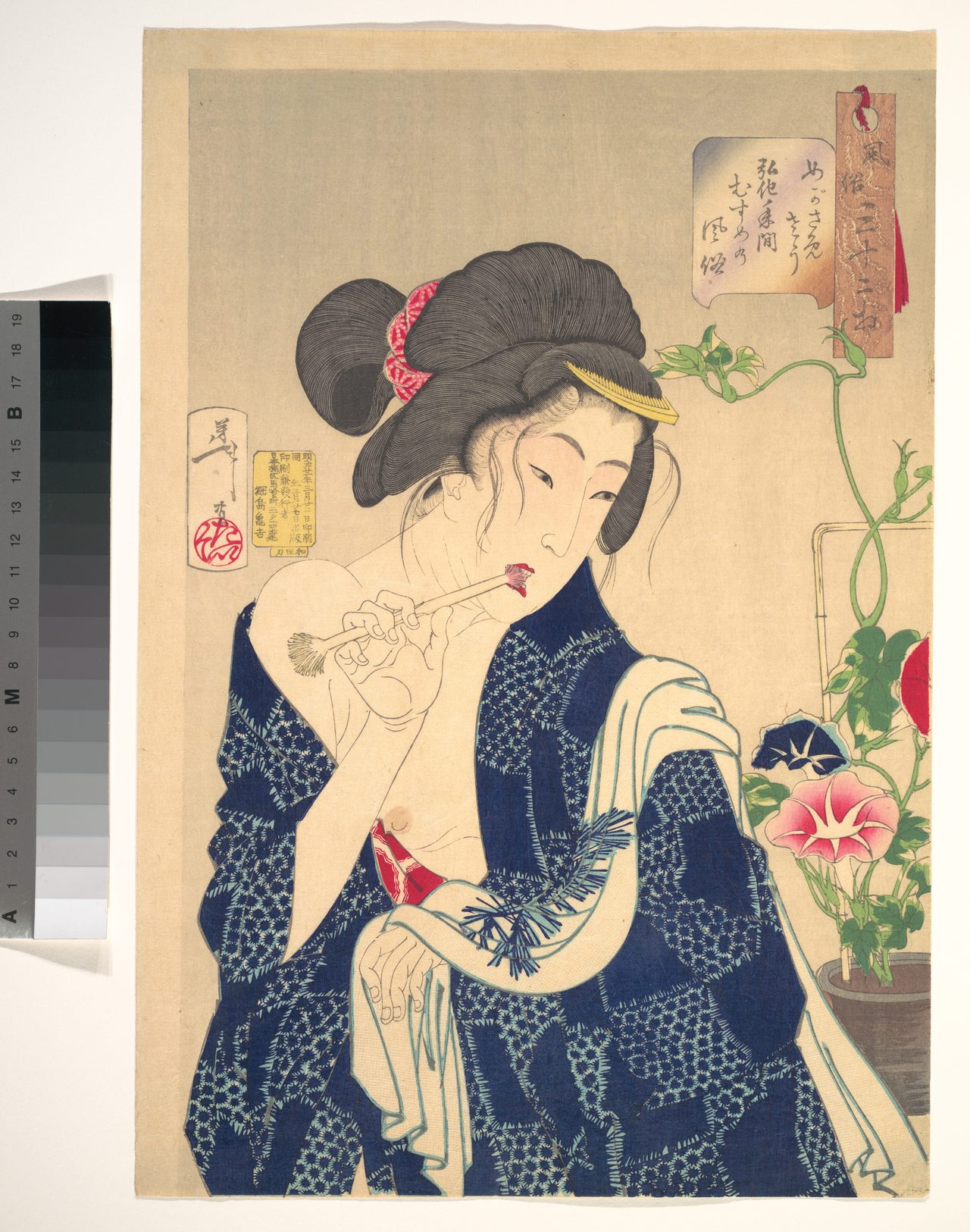
A girl of the 1840s with a frayed stick at her lips and a morning glory climbing beside her, in Tsukioka Yoshitoshi’s print of 1888.
- Image:
- Tsukioka Yoshitoshi, Waking Up: A Girl of the Kōka Era (1844–1848), woodblock print, 1888. The Metropolitan Museum of Art, 2005.349.
- Source:
- Wu Zimu, Mengliang lu (preface dated 1274), juan 13, our translation
Nylon toothbrush bristles went into production on 24 February 1938, by the Hagley Library’s account. The bristle brush is far older: a guide to Hangzhou written about 1274 names two toothbrush shops, and by 1291 a health manual was quoting a warning against the brushes. Around them, a twig bitten soft, a stick of the arak tree, a powder of burnt deer horn, a cloth on a finger. What 6 societies did about their teeth, with the original beside our English wherever the translation is ours.
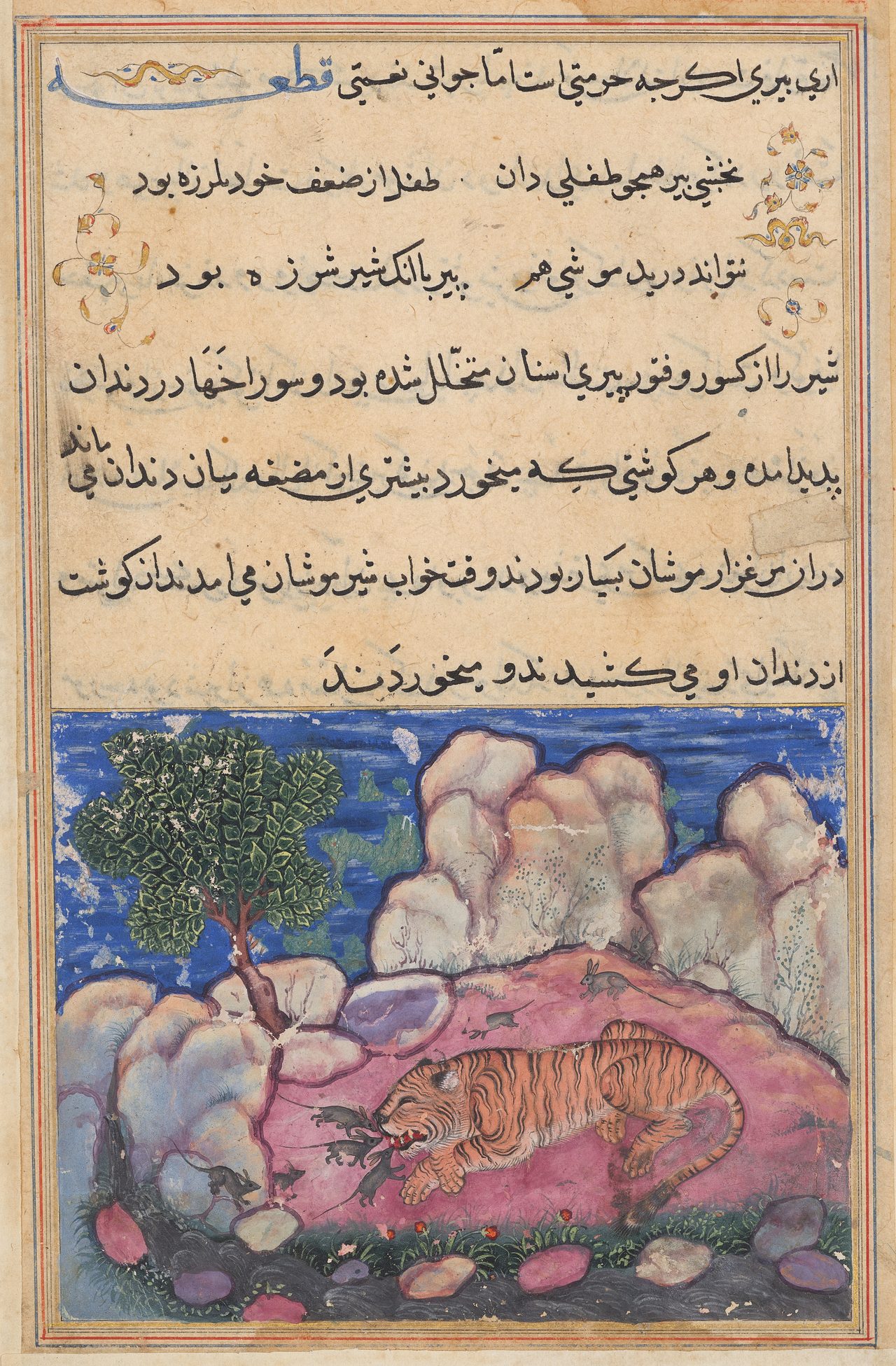
Mice at an old tiger’s teeth, from a Mughal Tuti-nama of about 1560. In the story he is a lion.
- Image:
- Mice at an old tiger’s teeth, painting from a Tuti-nama (Tales of a Parrot), Mughal court, c. 1560. The Cleveland Museum of Art, 1962.279.113.a.
- Source:
- The Cleveland Museum of Art, record 1962.279.113.a; Hagley Museum and Library (for 1938)
The problem, as a fable
In a Tuti-nama (Tales of a Parrot) painted at the Mughal court about 1560, mice eat the food trapped in an old lion’s teeth, and disturb him doing it. The painter made the lion a tiger; the museum’s record notes that the two were often interchangeable in Indian art.
“Before toothbrushes” needs one caution. The nylon-bristle toothbrush went on sale in 1938, but a brush with bristles is centuries older, as Hangzhou shows below.
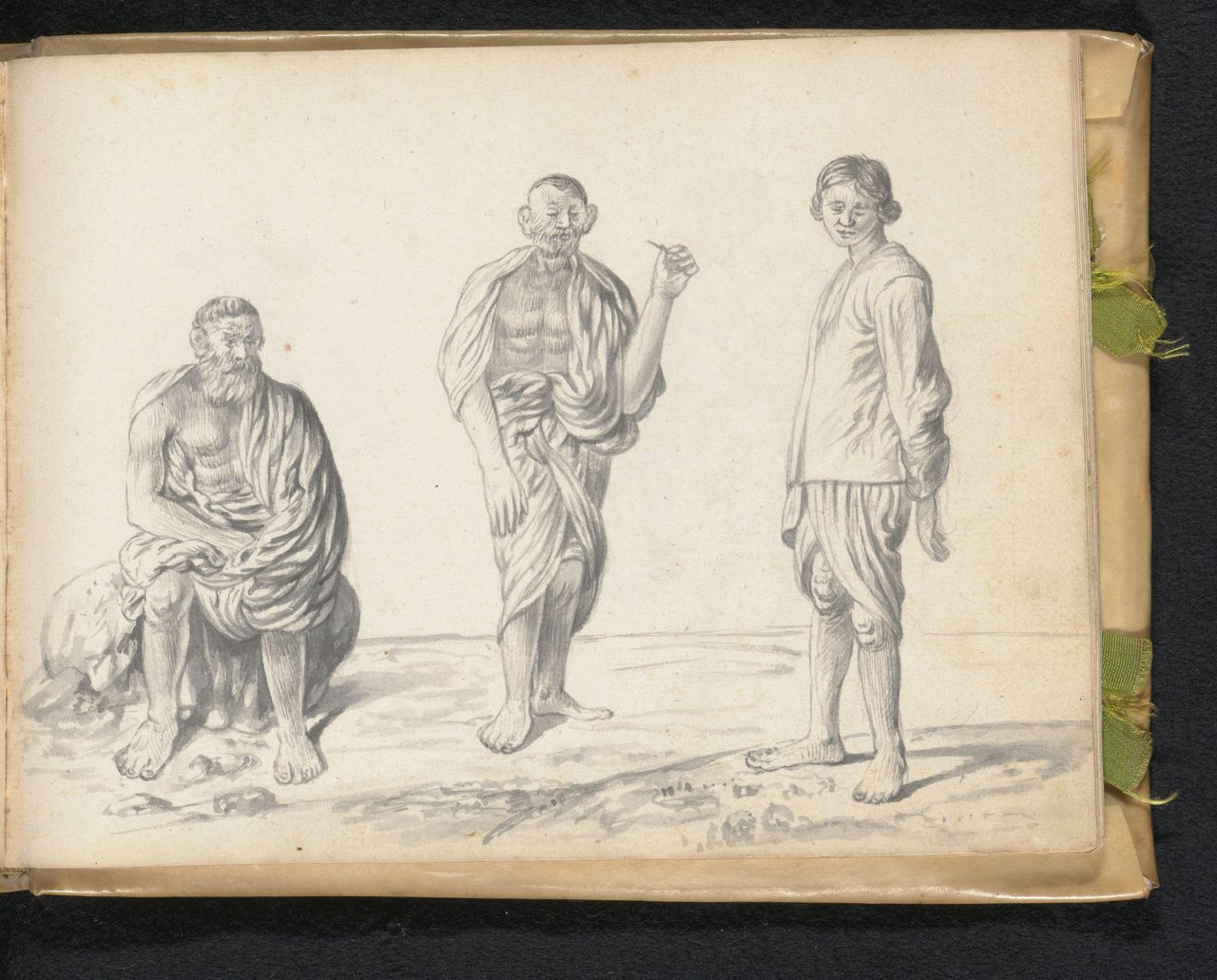
Three labourers drawn in Sri Lanka in 1662 by Esaias Boursse. By the museum’s account the two at left and centre are labourers from South India or Jaffna, and the small stick in the middle man’s raised hand is probably a toothpick.
- Image:
- Esaias Boursse, Three labourers, brush drawing, Sri Lanka, 1662. Rijksmuseum, NG-1996-6-109.
- Source:
- After the Sushruta Samhita, Chikitsita Sthana XXIV (Bhishagratna 1911); Yijing, A Record of the Buddhist Religion, tr. J. Takakusu (1896)
India: the twig
The Sushruta Samhita is a medical encyclopedia composed in Sanskrit about two thousand years ago, by the Suśruta Project’s account. Its instructions for the morning, in our paraphrase of K. L. Bhishagratna’s English of 1911: rise early and clean the teeth with a twig cut fresh: straight, sound, with one knot at most, twelve finger-breadths long and as thick as the little finger. The tree is chosen by season and temperament; of the bitter trees, nimba (neem) is the best. Bite the tip into a soft brush, put on a paste of honey, spices, rock salt and oil, and clean each tooth on its own, taking care not to hurt the gum. Then scrape the tongue with a thin strip of gold, silver or wood, and gargle with oil.
Not everyone was to do it. The same chapter forbids the twig to anyone with a complaint of the mouth or throat, a cough, asthma, hiccough, vomiting, indigestion, epilepsy, facial paralysis or ear-ache, and to heavy drinkers or anyone worn out from drinking.
The monk Yijing described the practice in A Record of the Buddhist Religion as Practised in India and the Malay Archipelago (A.D. 671-695): “Every morning one must chew tooth-woods, and clean the teeth with them, and rub off the dirt of the tongue as carefully as possible.” The stick is about twelve finger-breadths long: “Chew softly one of its ends, and clean the teeth with it”. For the elders there is “the stick hammered at one end and made soft”. Yijing claimed that “Tooth-ache is very rare in India owing to their chewing the tooth-wood”, and added: “Even infants of three years old are taught how to do it.” (tr. J. Takakusu, 1896, pp. 33 to 35.)
A used stick was not simply dropped. It is thrown away “after having made three fillips with the fingers, or after having coughed more than twice”. Takakusu’s footnote gives the rule behind it: nothing was to be thrown away “without making some noise beforehand for a warning”.
The Anguttara Nikaya counts “five benefits of using chew sticks”: “It’s good for your eyes, you don’t get bad breath, your taste-buds are cleaned, bile and phlegm don’t cover your food, and food agrees with you.” (5.208, tr. Bhikkhu Sujato, SuttaCentral, CC0.)
Arabia: the siwak
In al-Bukhari’s collection, Abu Hurayra reports a saying of the Prophet Muhammad:
“Abu Hurayra (God be pleased with him) reports that the Messenger of God (God bless him and give him peace) said: ‘Were it not that I would be putting a hardship on my community (or: on the people), I would have ordered them to use the siwak with every prayer.’”
Sahih al-Bukhari, no. 887, Book of the Friday Prayer. Our translation.
عَنْ أَبِي هُرَيْرَةَ ـ رضى الله عنه ـ أَنَّ رَسُولَ اللَّهِ صلى الله عليه وسلم قَالَ "لَوْلاَ أَنْ أَشُقَّ عَلَى أُمَّتِي ـ أَوْ عَلَى النَّاسِ ـ لأَمَرْتُهُمْ بِالسِّوَاكِ مَعَ كُلِّ صَلاَةٍ".
“Or: on the people” is the narrator’s own doubt about the wording, not ours.
A second report, from Aisha, stands in al-Bukhari’s chapter on the Prophet’s illness and death:
“From Aisha: Abd al-Rahman ibn Abi Bakr came in to the Prophet (God bless him and give him peace) while I was holding him propped against my chest. Abd al-Rahman had a fresh siwak that he was cleaning his teeth with, and the Messenger of God (God bless him and give him peace) kept his eyes on it. So I took the siwak, broke it, shook it out and made it pleasant, then handed it to the Prophet (God bless him and give him peace), and he cleaned his teeth with it. I never saw the Messenger of God (God bless him and give him peace) clean his teeth better than that.”
Sahih al-Bukhari, no. 4438, Book of the Military Expeditions. Our translation.
عَنْ عَائِشَةَ، دَخَلَ عَبْدُ الرَّحْمَنِ بْنُ أَبِي بَكْرٍ عَلَى النَّبِيِّ صلى الله عليه وسلم وَأَنَا مُسْنِدَتُهُ إِلَى صَدْرِي، وَمَعَ عَبْدِ الرَّحْمَنِ سِوَاكٌ رَطْبٌ يَسْتَنُّ بِهِ، فَأَبَدَّهُ رَسُولُ اللَّهِ صلى الله عليه وسلم بَصَرَهُ، فَأَخَذْتُ السِّوَاكَ فَقَصَمْتُهُ وَنَفَضْتُهُ وَطَيَّبْتُهُ، ثُمَّ دَفَعْتُهُ إِلَى النَّبِيِّ صلى الله عليه وسلم فَاسْتَنَّ بِهِ، فَمَا رَأَيْتُ رَسُولَ اللَّهِ صلى الله عليه وسلم اسْتَنَّ اسْتِنَانًا قَطُّ أَحْسَنَ مِنْهُ
“Broke it” is the sure part of the verb. A shorter report, no. 890, reads فَقَصَمْتُهُ ثُمَّ مَضَغْتُهُ, broke it, then chewed it.
The siwak is still a chewing stick cut from the stem, twig or root of the arak tree (Salvadora persica), about a centimetre thick and 15 centimetres long. Soaked, its end is crushed until it looks like a brush. One study in Cameroon, cited by a 2021 review, found 85 percent of adults using one (Ramli, Mohd-Dom and Mohd-Said 2021).
Rome: powders, and a courtroom
About 155 to 161 CE Apuleius stood trial at Sabratha, in Libya, before Claudius Maximus. The prosecution read out his own verses: “They began by reading one of my jeux d’esprit”, a letter in verse about a tooth powder, sent to one Calpurnianus. Four of its lines, in H. E. Butler’s English of 1909: “This delicate dust of Arab spices fine / With ivory sheen shall make thy mouth to shine, / Shall smooth the swollen gums and sweep away / The relics of the feast of yesterday.”
The accuser, Apuleius says, “condemned my administration of a tooth-powder with fiercer indignation than has ever been shown in condemning the administration of a poison” (Apologia 7). His answer takes two words: “‘Dentes splendidas’: ignosce munditiis”, in Butler’s English “‘You clean your teeth.’ Excusable cleanliness.” (Apologia 103.)
In the 40s CE, under Claudius, Scribonius Largus wrote down the powders themselves, and who used them:
“A tooth powder that makes the teeth shine and strengthens them. Take a sextarius of barley flour, sprinkle it with vinegar mixed with honey, knead it for a good while, and divide it into six little balls. Flatten them, work in half an ounce of rock salt, then bake them in an oven until they turn to charcoal. Then grind the balls and add as much spikenard as seems enough to give it a scent. Octavia, sister of Augustus, used this.”
Scribonius Largus, Compositiones 59, ed. Helmreich 1887, p. 26. Our translation.
Dentifricium, quod splendidos facit dentes et confirmat: Farinae hordeaciae sextarium conspergere oportet aceto cum melle mixto et subigere diutius atque ita in globulos dividere sex; quibus dilatatis admiscere salis fossicii semunciam, deinde furno coquere, donec in carbonem redigantur. Tunc terere oportebit eos globulos et admiscere spicae nardi quod satis videbitur ad odorem faciundum; hoc Octavia Augusti soror usa est.
“For toothache and for strengthening the teeth, the bark of the edulis root does good, dried in the sun, pounded and sifted; so does white glass, the kind that looks like crystal, carefully ground, with spikenard mixed in. Many people also use a tooth powder of this kind. They gather the herb urceolaris (pellitory) when it is already in seed, as much as they can, with the root; wash it and dry it for a day; the next day steep it in fresh strong brine; on the third day squeeze it out and pack it into a new pot, laying rock salt between like floors, and bake it through in the furnace of the baths until it turns to charcoal. Afterwards they grind it and mix in enough spikenard, a third part. Besides making the teeth white, this also strengthens them. The Augusta is known to have used it. Messalina, wife of our god Caesar, uses this one: a sextarius of deer horn burnt to ash in a new pot, an ounce by weight of Chian mastic, and an ounce and a half by weight of sal ammoniac.”
Scribonius Largus, Compositiones 60, ed. Helmreich 1887, p. 27. Our translation.
Ad dentium dolorem et confirmationem bene facit radicis edulis cortex sole arefacta et contusa, cribrata; item vitrum candidum, quod simile crystallo est, diligenter tritum admixta spica. Utuntur plerique etiam huiusmodi dentifricio: Herbam urceolarem legunt, cum iam in semine est, quam plurimam cum radice, deinde lotam uno die siccant, postridie recenti muria dura macerant, tertio die expressam olla nova conponunt, subinde salis fossicii quasi tabulata interponunt atque ita percoquunt fornace balneariorum, donec in carbonem redigantur. Postea tritae ad tertias admiscent spicae nardi quod satis est. Hoc cum eo quod candidos facit dentes, tum etiam confirmat. Augustam constat usam. Nam Messalina dei nostri Caesaris hoc utitur: Cornorum cervi ustorum in olla nova ad cinerem redactorum sextario uno, mastiches Chiae pondo uncia, salis ammoniaci pondo sescuncia.
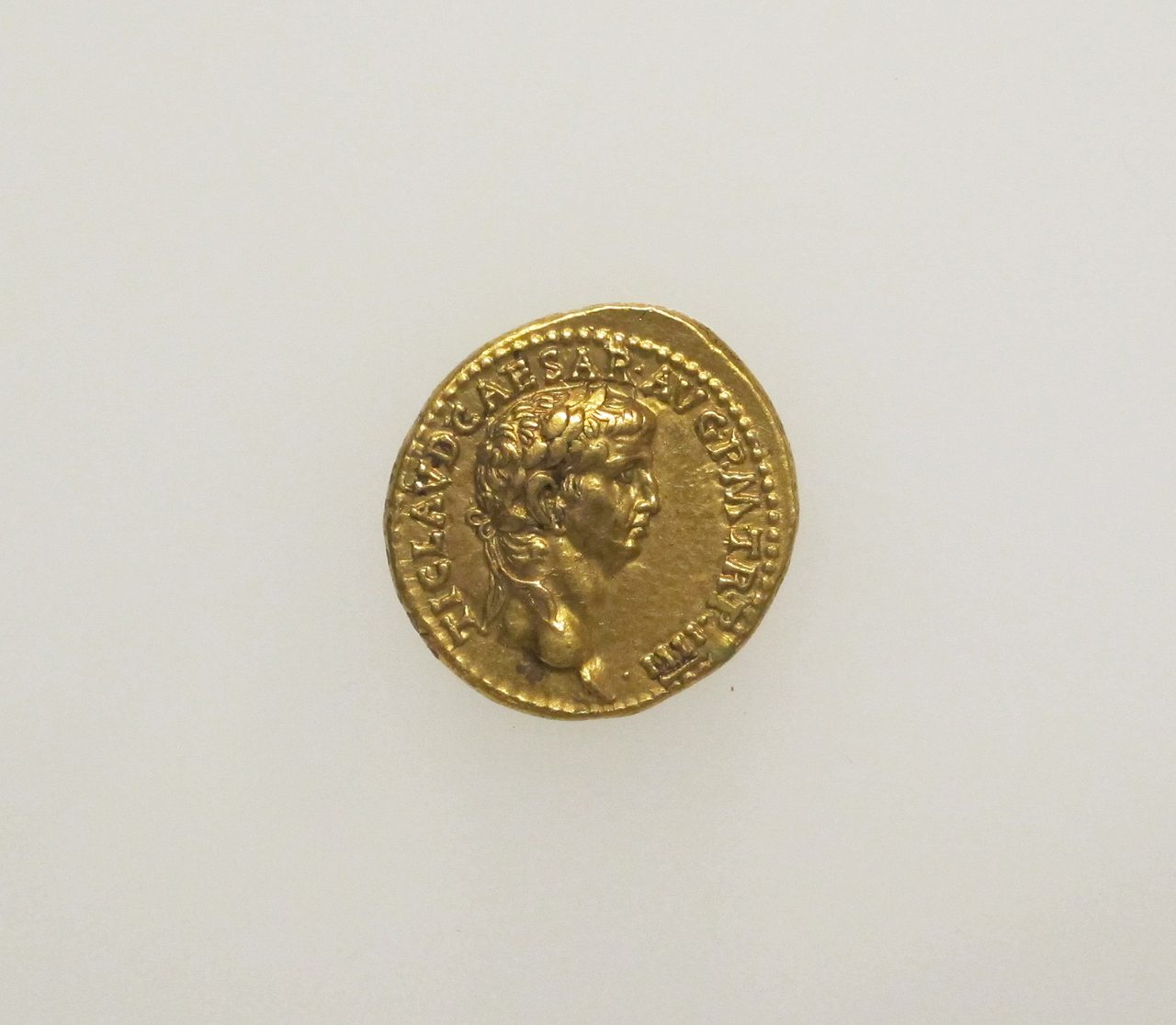
The emperor Claudius on a gold aureus of 41 to 42 CE: the Caesar of Scribonius’s chapter, and Messalina’s husband. The coin shows no powder.
- Image:
- Gold aureus of Claudius, Roman, 41 to 42 CE. The Metropolitan Museum of Art, 99.35.138.
- Source:
- Apuleius, Apologia 6 and 103, tr. H. E. Butler (1909); Scribonius Largus, Compositiones 60 (Helmreich 1887), our translation
“The Augusta” stays unnamed because Scribonius doesn’t say which. The ground glass is a toothache remedy, not a whitener. Edulis stays in Latin, since it may be a plant’s name. Messalina is alive in the chapter, one of the two clues its editor uses to date the book: after Claudius’s campaign in Britain and shortly before her death.
Martial gives a tooth powder a voice: “Let the fair and young use me. I am not accustomed to polish false teeth.” (Epigrams 14.56, Bohn’s Classical Library, 1897.) And of two women: “Thais has her own, Laecania bought ones.” (5.43.) Pliny the Elder held that picking the teeth with a vulture’s feather sours the breath, and that a porcupine’s quill strengthens the teeth (Natural History 30.9).
Hangzhou, about 1274: toothbrush shops
Wu Zimu’s Mengliang lu is a guide to Hangzhou; its preface is dated mid-autumn 1274. The chapter on shops runs through the famous ones:
“Among those famous and handed down since the Chunyou years: Big Knife Wei’s cooked meats at Cat Bridge, Pan’s prepared-medicine shop, [...] the Liu, Lü and Chen families’ coloured-silk shops, the Shu family’s paper-goods shop, [...] the Tong family’s tallow-tree candle shop, [...] the Xu family’s paper-goods shop at the mouth of Lion Lane, the Ling family’s toothbrush shop, the Guanfu elixir room, [...] Chen Huajiao’s wheat-food shop at the mouth of Gold Lane, Master Fu’s toothbrush shop, Commander Yang’s medicine shop [...]”
Wu Zimu, Mengliang lu, juan 13, “Shops”. Our translation.
自淳祐年有名相傳者,如貓兒橋魏大刀熟肉,潘節幹熟藥鋪,[...] 劉家、呂家、陳家彩帛鋪,舒家紙劄鋪,[...] 童家桕燭鋪,[...] 獅子巷口徐家紙劄鋪,淩家刷牙鋪、觀復丹室,[...] 金子巷口陳花腳面食店,傅官人刷牙鋪,楊將領藥鋪 [...]
The list runs name, goods, shop: a silk shop, a paper-goods shop, a candle shop. On that pattern 刷牙鋪 is a toothbrush shop. The reading is ours. Both blind translators chose it unprompted, and both named the doubt: a shop for tooth-care goods in general, or a tooth-cleaning business. Two texts support the brush. The same chapter has toothbrushes carried through the lanes and streets for sale, with the combs:
“There are also naozi, wooden combs, fine-toothed combs, brushes, toothbrushes, jianzhuang, ink-washing bowls, mouth-rinsing bowls, guanshu, collar cloths, needles and thread [...]”
Wu Zimu, Mengliang lu, juan 13, “Goods of every kind”. Our translation.
又有鐃子、木梳、篦子、刷子、刷牙子、減裝、墨洗、漱盂子、冠梳、領抹、針線 [...]
And in 1291 toothbrushes are things made of horse-tail hair (below). The three words left in Chinese split our two blind translators.
The Chunyou years are 1241 to 1252. The preface says 1274, but the Siku editors doubted that date, since the preface looks back on it all as a dream, as if the Song had already fallen, and in 1274 it had not. “By the 1270s” is safe either way: the shops were famous from the Chunyou years.
“Master” stands for guanren, a word for an office-holder. A Qing word-book that quotes the Mengliang lu’s shop names, Master Fu’s among them, explains it:
“Note: in the Tang only those who held office could be called guanren; not so in the Song. [...] Wu Zimu’s Mengliang lu also has Xu Guanren’s headcloth shop, Cui Guanren’s fan-leaf shop, Zhang Guanren’s book shop and Fu Guanren’s toothbrush shop. At that time, it seems, hardly anyone was not a guanren.”
Zhai Hao, Tongsu bian, juan 18. Our translation.
〔按〕唐時惟有官者,方得稱官人,宋乃不然,[...] 吳自牧夢粱錄、又有徐官人襆頭鋪,崔官人扇面鋪,張官人文籍鋪,傅官人刷牙鋪,當時殆無不官人者矣。
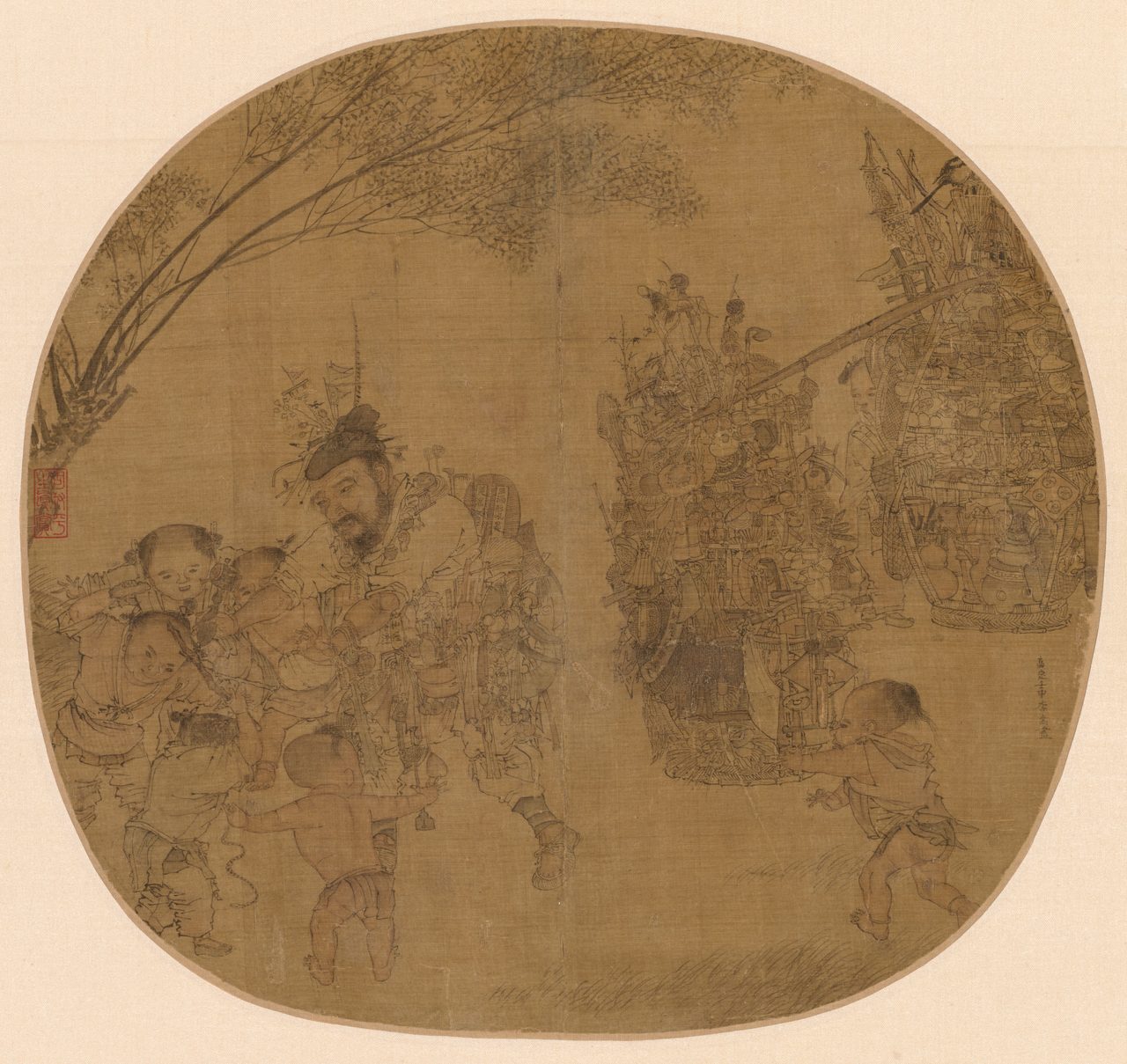
A peddler hung with goods bends to a group of children; his two laden carrying frames stand at right. Painted in 1212 by Li Song, a court artist from Hangzhou. No toothbrush can be picked out among the goods.
- Image:
- Li Song, The Knickknack Peddler, ink and color on silk, 1212. The Cleveland Museum of Art, 1963.582.
- Source:
- Wu Zimu, Mengliang lu (preface dated 1274), juan 13, our translation
The twig was in China before the brush. Yijing, in the 7th century: “Some in China use small sticks of willow which they chew completely in their mouth without knowing how to rinse the mouth and remove the juice.” (tr. Takakusu, p. 35.)
China, 1291 to 1488: horse-tail hair, and dawn or night
Li Pengfei’s health manual, its preface dated 1291, quotes a book it does not name:
“The book says: [...] On rising, do not use a toothbrush: it may loosen the roots and leave the teeth gappy and very easily damaged, and in time it brings toothache. For toothbrushes are all made of horse-tail hair, which does great harm. Those who pull teeth nowadays all have horse-tail ash, for horse tail can rot the roots of the teeth.”
Li Pengfei, Sanyuan canzan yanshou shu, juan 2, “Rising and resting”. Wikisource prints 雲 for 云. Our translation.
《書》云:[...] 早起不可用刷牙子,恐根浮,兼牙疏易損極,久之患牙疼。蓋刷牙子皆是馬尾為之,極有所損。今時出牙者,盡有馬尾灰,蓋馬尾能腐齒根。
Li Shizhen’s Bencao gangmu (Ming) cites the warning in its entry on the horse, in a short form, 刷牙用馬尾,令齒疏損: brushing the teeth with horse tail makes them gappy and damaged.
Hu Sihui’s dietary manual, presented to the emperor in 1330, takes a side on the hour:
“Brushing the teeth at dawn is not as good as brushing them at night: then no tooth trouble arises. Brush them with salt at dawn, and there is no tooth trouble day to day.”
Hu Sihui, Yinshan zhengyao, juan 1, “Avoidances for nourishing life”. Our translation.
凡清旦刷牙,不如夜刷牙,齒疾不生。凡清旦盐刷牙,平日無齒疾。
In 1488 the Korean official Ch’oe Pu travelled through China and kept a diary:
“Moreover, south of the river people love to adorn themselves: men and women all carry mirror cases, combs and fine-toothed combs, toothbrushes and the like. North of the river it is the same, except that you do not see anyone carrying them.”
Ch’oe Pu, Pyohae rok, juan 3. Our translation.
且江南好冶容,男女皆帶鏡奩、梳篦、刷牙等物。江北亦然,但不見帶之者。
The river is the Yangzi. The second sentence is ambiguous: “the same” may be the taste for adornment, not the things carried.
A Korean textbook of spoken Chinese, the Pak tongsa, first written in late Yuan or early Ming by one account, teaches the shopping:
“Brother, please, let’s go into this tea house and have some tea. Sit down, brother. [...] Brush-seller, bring them over. A hat brush and a shoe brush, one of each, two toothbrushes and two combs: how much? What is there to haggle about? / Bring two hundred copper cash. Brother, I’m giving you this one toothbrush and one comb: take them and use them, and don’t lose them.”
Pak tongsa, the tea-house scene, in the form attributed to Choe Sejin. Our translation.
請哥這茶房裡吃些茶去來。坐的,哥。[...] 賣刷子的將來。這帽刷、鞋刷各一個,刷牙兩個,掠頭兩個怎麼賣?這的有甚麼商量處? / 將二百銅錢來。哥,我與你這一個刷牙、一個掠頭,將去使,休吊了。
The speakers are unmarked in the text. We have no scholar’s date for this scene, so it carries no year here.
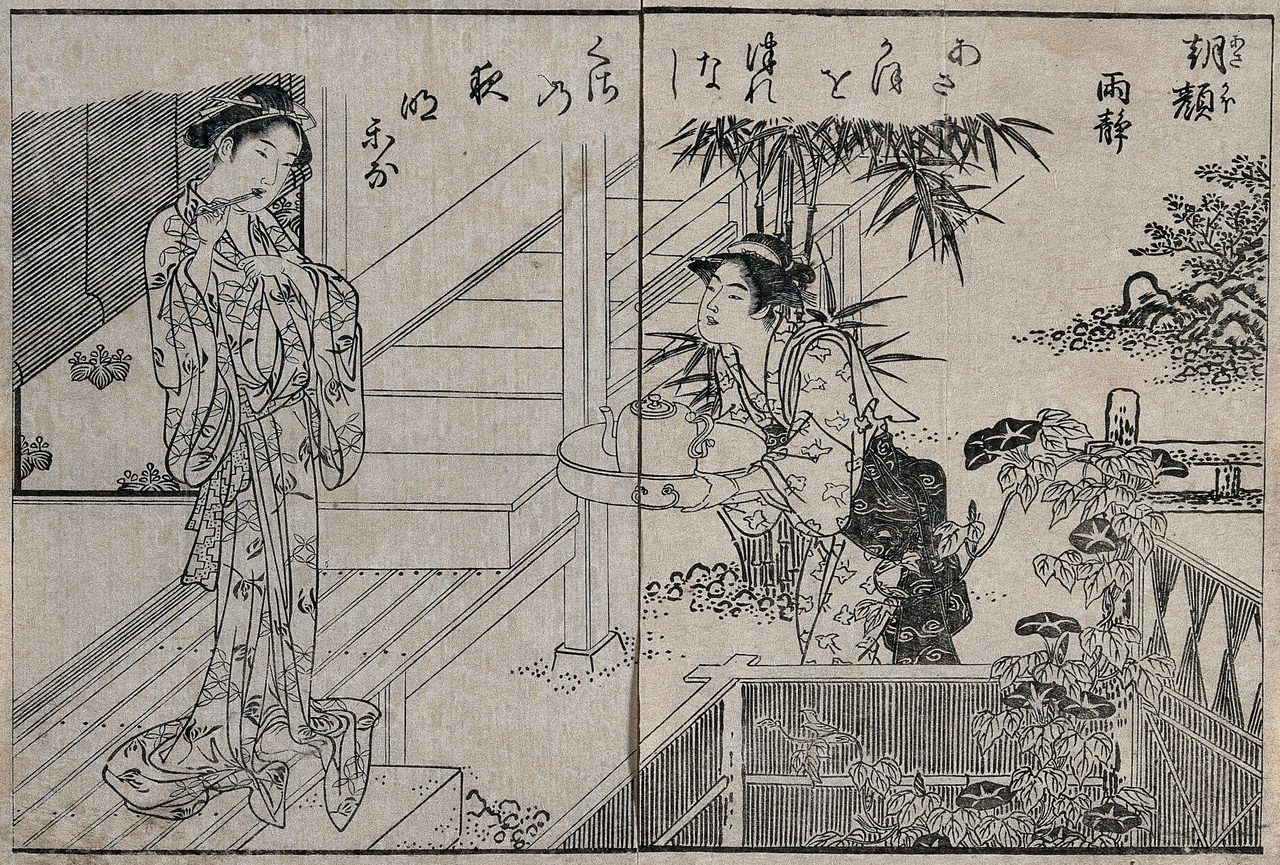
A woman cleans her teeth on a veranda while a maid brings washing water past the morning glories. Woodcut by Kitao Shigemasa, 1778.
- Image:
- Kitao Shigemasa, a woman cleaning her teeth, woodcut, 1778. Wellcome Collection. Public Domain Mark.
- Source:
- Wellcome Collection 565612i; Art Institute of Chicago 1925.2826 and 1925.2854; The Met 2005.349; Murai 2001
Japan: a stick at dawn
The evidence here is pictures. In Kitao Shigemasa’s woodcut of 1778 a woman on a veranda holds a short stick to her mouth while a servant brings water; morning glories grow at the railing. The Art Institute of Chicago titles Torii Kiyonaga’s print of about 1779 Woman Admiring Morning Glories while Brushing Her Teeth (“Brushing” is the museum’s word) and Isoda Koryūsai’s of about 1775 Courtesan Admiring Morning Glories while Cleaning Her Teeth. In Tsukioka Yoshitoshi’s print of 1888, a girl of the 1840s waking up, the slender stick ends in a frayed tuft, and the morning glories are there again. That the flowers were a set companion of the morning’s tooth-cleaning is our estimate from these four prints, not a museum’s claim.
Tooth powder is said to have gone on sale in Japan in 1643, to whiten the teeth and clear bad smells (Murai 2001, citing an older source). A health manual of 1713, the Yōjōkun, advised rinsing the mouth a few times with hot tea after meals and with warm salted tea at night. At New Year, eating hard things such as dried rice cake was meant to harden the teeth, and with them to lengthen life (the Rijksmuseum’s note on a print by Totoya Hokkei, about 1822).

Torii Kiyonaga, Woman Admiring Morning Glories while Brushing Her Teeth, about 1779.
- Image:
- Torii Kiyonaga, Woman Admiring Morning Glories while Brushing Her Teeth, color woodblock print, c. 1779. The Art Institute of Chicago, 1925.2826.
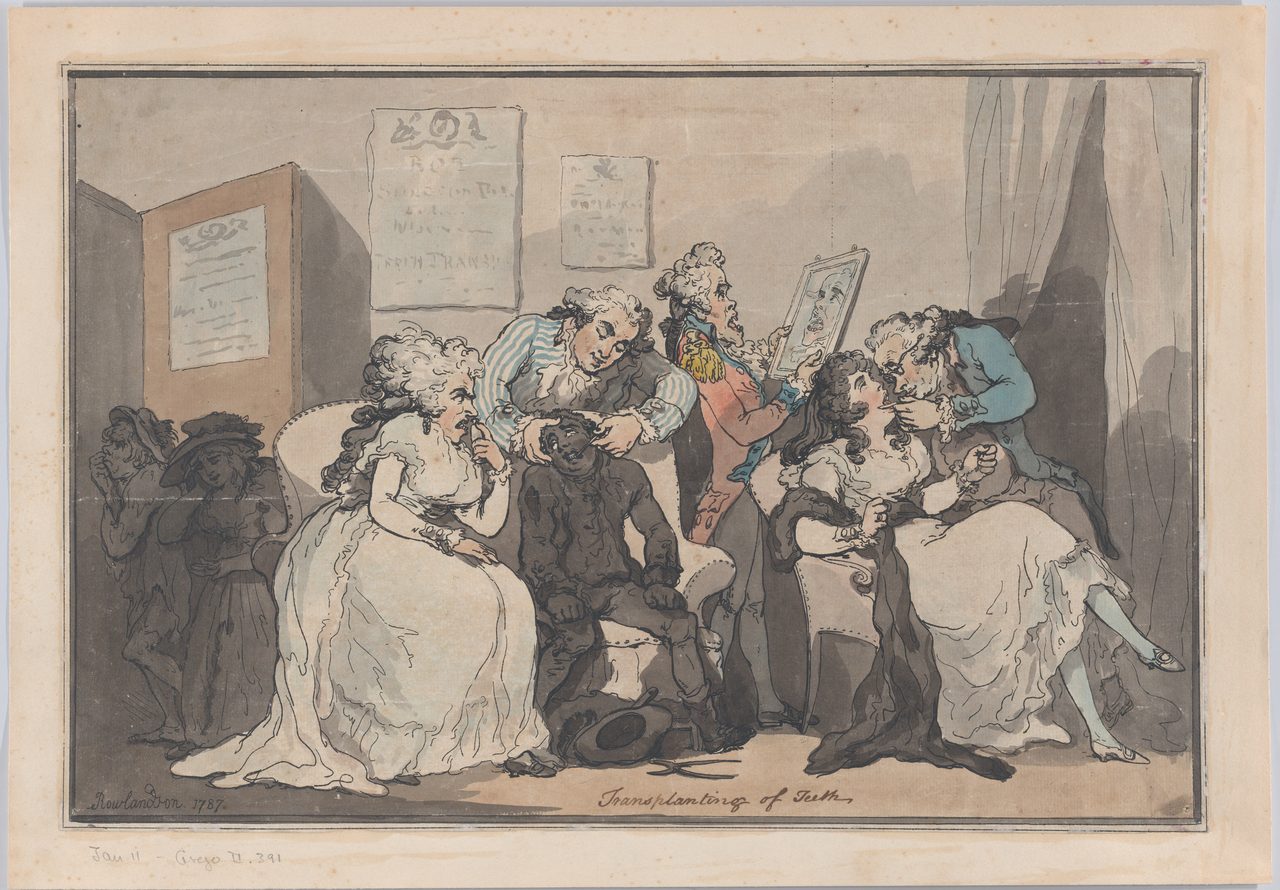
Thomas Rowlandson, Transplanting of Teeth, 1787. A dentist draws a tooth from a poor boy while a lady waits beside him; at right a second dentist sets a tooth in a young woman’s mouth.
- Image:
- Thomas Rowlandson, Transplanting of Teeth, hand-colored etching and aquatint, 1787. The Metropolitan Museum of Art, 59.533.2057.
- Source:
- Anthony Wood, Life and Times, ed. Clark, vol. III (1894); John Hunter, A Practical Treatise on the Diseases of the Teeth (1778)
England, 1691 to 1787: a tooth brush on the bill
Anthony Wood, the Oxford antiquary, kept notes of what he owed. In his almanac for 1690: “Stockings, of the taylor : toothbrush, (of) J. Barret.” And on the page his editor heads January, 1691: “Owing to Mr. Barret Jan. 30, 1690 [...] F., [...] tooth brush, half an ounce of tobacco, thread.” The date is 30 January 1691. John Barret supplied Wood with shirts and other goods, and Wood had known him for forty years or more when he died; the notes don’t say where the brush came from.
By 1778 brushing was ordinary. John Hunter, in A Practical Treatise on the Diseases of the Teeth, writes that tartar can beat “the common methods of prevention, such as washing and brushing the Teeth”; some people “rub them with a piece of cloth on the fore finger”, others use “the dust of a burnt cork, burnt bread”.
The same book has a chapter on transplanting teeth, “one of the nicest of all operations” (nicest, in 1778, meaning the most exacting). The donor’s “should be a full grown young Tooth”, preferably “that of a female, for female Teeth are in general smaller”. Hunter also set a human tooth in a cut in a cock’s comb, and months later found its vessels joined to the comb’s: “I succeeded but once out of a great number of trials.”
Thomas Rowlandson drew the trade in 1787. In the Wellcome Collection’s description of a later copy of the print, a dental surgeon and his assistant pull teeth from poor children and fit them straight into the mouths of rich, elderly clients.
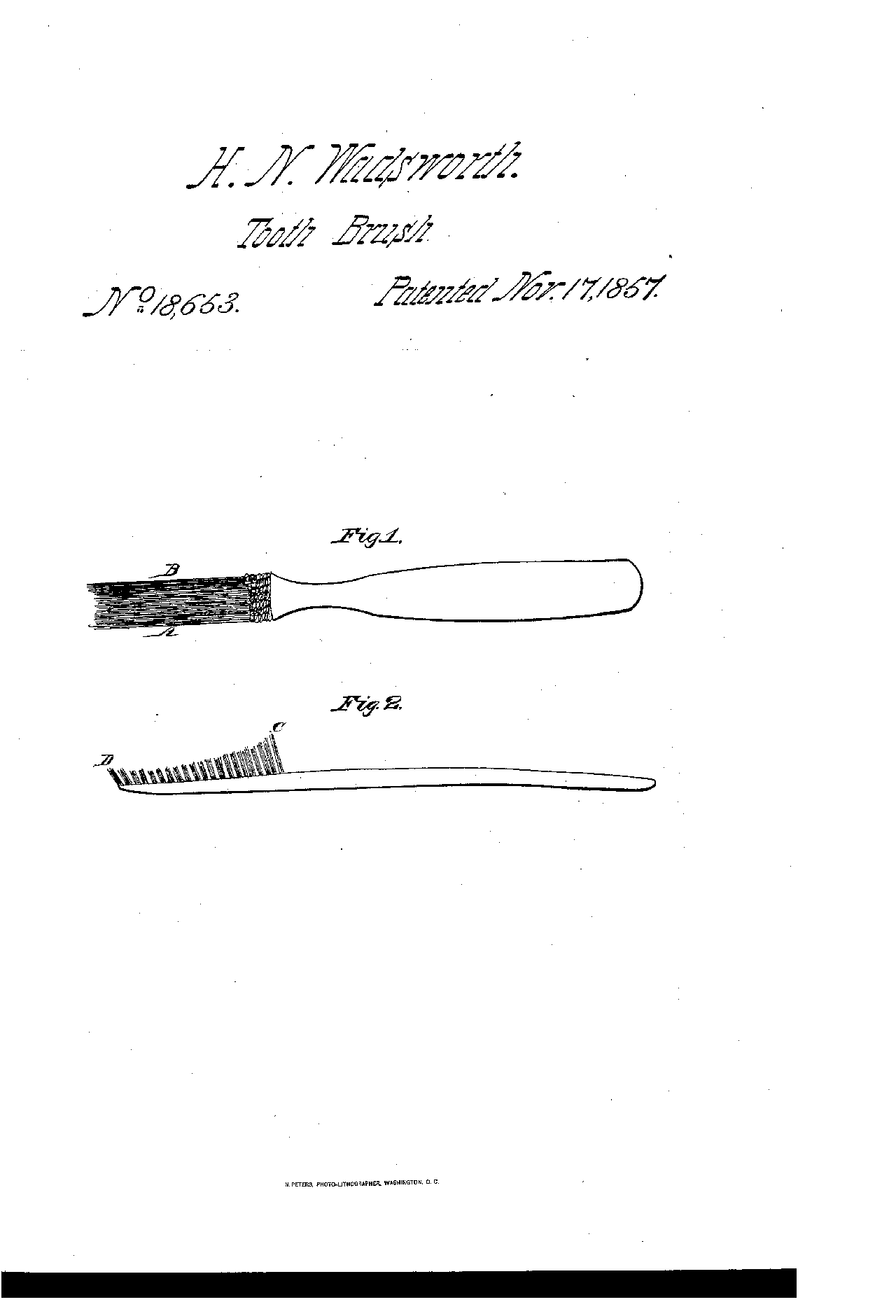
H. N. Wadsworth’s Tooth-Brush, US Patent 18,653, 17 November 1857, an improvement on “the common brush”. Not nylon: the 1938 patent has no drawing.
- Image:
- H. N. Wadsworth, Tooth-Brush, US Patent 18,653, drawing, 17 November 1857. United States Patent and Trademark Office.
- Source:
- Hagley Museum and Library (2022, 2023); US Patents 2,130,948 (1938) and 18,653 (1857). Full list: livingbefore.com
1938: the nylon bristle
On 24 February 1938, by the Hagley Library’s account, DuPont began making nylon toothbrush bristles at a plant in Arlington, New Jersey. They replaced boar hair imported from Siberia, Poland and China. DuPont made the bristle; Weco, which held exclusive rights to it until 1940, made Dr. West’s Miracle Tuft brush. Hagley calls it “the first toothbrush to employ nylon bristles”; “first” is Hagley’s word.
The dated document is a patent, and it needs care. US Patent 2,130,948, “Synthetic fiber”, was applied for on 9 April 1937 and granted on 20 September 1938, seven months after Hagley’s production date. It never names a toothbrush. It says that “Filaments having diameters ranging from 0.003 to 0.060 inch are especially suitable as bristles” and that “The bristles had good snap, flexibility, and toughness”, and its claim 53 reads: “A brush containing bristles which are obtainable by condensation polymerization from a diamine and a dibasic carboxylic acid.” It has no drawing. The toothbrush link is Hagley’s.
By the 1950s, 80 percent of toothbrushes had nylon bristles, by the account of the University of the Pacific’s dental museum. In November 1941 a Wellington paper reported that nylon would reach New Zealand first as toothbrush bristles, and a chemist’s advert promised nylon tufts that would not go soggy.
The stories that don’t hold up
- “The toothbrush was invented in China in 1498.”
The University of the Pacific’s dental museum says only that it is “thought to have originated in China in 1498”, and gives no source. Hangzhou had toothbrush shops two centuries earlier, the brushes of 1291 were horse-tail hair, and Ch’oe Pu saw southerners carrying toothbrushes in 1488 (all above).
- “William Addis invented the toothbrush in 1780.”
Anthony Wood owed for a tooth brush in 1691, and in 1778 John Hunter listed brushing among the common methods (above). By the Pacific museum’s account, the manufacture of a toothbrush with a cow-bone handle and boar bristle began in England in 1780; it names no maker.
- “Early toothbrushes were pig bristle.”
Not always. Chinese brushes of 1291 were horse-tail hair; England’s factory brushes of 1780 were boar bristle (Pacific), and before 1938 most toothbrushes were boar hair, the dearer ones badger or horsehair (Hagley).
- “Romans cleaned their teeth with urine.”
Catullus mocks one Celtiberian: “in the Celtiberian land early in the morning they piss and scrub their teeth and pinky gums with it” (poem 39, tr. Leonard C. Smithers, 1894). Diodorus Siculus says the Celtiberians washed their bodies with urine and cleaned their teeth with it (5.33.5). Apuleius calls it “the filthy fashion in vogue among the Iberians” (tr. Butler). None of the three says it of Romans.
- “Romans used mouse brains as toothpaste.”
Pliny puts mouse-head ash in a dentifrice, as “some persons” prefer (Natural History 28.49). The mouse brains are a remedy for delirium, and of that one he asks “who could possibly do it” (30.29).
- “The toothbrush was nylon’s first product.”
Hagley says the bristles were one of nylon’s first consumer uses. Nylon yarn for stockings followed in December 1939.
- “Siwak sticks were dug up at Mesopotamian, Egyptian and Etruscan sites.”
The Pacific museum says so without a source. The 2021 review says only that the stick was “used by various civilizations”.
Sources
- Sushruta Samhita, Chikitsita Sthana XXIV, in K. L. Bhishagratna’s English, vol. 2 (Calcutta, 1911), pp. 480 to 482, paraphrased . Its age, by the Suśruta Project’s account.
- Yijing (I-tsing), A Record of the Buddhist Religion as Practised in India and the Malay Archipelago (A.D. 671-695), ch. VIII, tr. J. Takakusu (Oxford, Clarendon Press, 1896), pp. 33 to 35 and the note on p. 34.
- Anguttara Nikaya 5.208, tr. Bhikkhu Sujato, SuttaCentral, CC0.
- Al-Bukhari, Sahih al-Bukhari, nos. 887, 890 and 4438, Arabic text: sunnah.com ; sunnah.com ; sunnah.com.
- Ramli, Mohd-Dom and Mohd-Said, BMC Oral Health 21:618 (2021), CC BY 4.0.
- Apuleius, Apologia 6, 7 and 103, tr. H. E. Butler (Oxford, Clarendon Press, 1909) . Latin text at The Latin Library.
- Scribonius Largus, Compositiones 59 and 60, ed. G. Helmreich (Leipzig, Teubner, 1887), pp. 26 to 27, read on the page images.
- Martial, Epigrams 14.56 and 5.43, Bohn’s Classical Library (1897): www.tertullian.org ; www.tertullian.org.
- Pliny the Elder, Natural History 28.49, 30.9 and 30.29 (Bohn numbering), tr. John Bostock and H. T. Riley, vol. 5 (London, Bohn, 1856), pp. 339, 432 and 453, read on the scan ; the same text at Perseus: www.perseus.tufts.edu ; www.perseus.tufts.edu ; www.perseus.tufts.edu.
- Wu Zimu, Mengliang lu, juan 13, the sections 鋪席 and 諸色雜貨 . The preface and the Siku editors’ note on its date.
- Zhai Hao, Tongsu bian, juan 18, entry 官人.
- Li Pengfei, Sanyuan canzan yanshou shu (preface 1291), juan 2.
- Li Shizhen, Bencao gangmu, the entry on the horse.
- Hu Sihui, Yinshan zhengyao (presented 1330), juan 1.
- Ch’oe Pu, Pyohae rok (1488), juan 3.
- Pak tongsa, in the form attributed to Choe Sejin . On the dating of its twin textbook, the Nogeoldae, the Encyclopedia of Korean Culture.
- The era years (Chunyou 1241 to 1252, and the years 1274, 1291, 1330 and 1488) were read on Academia Sinica’s 兩千年中西曆轉換.
- Murai, Journal of the Japanese Society of Periodontology 43 (2001), p. 197, abstract.
- Rijksmuseum, catalogue note on Totoya Hokkei’s print RP-P-1958-354.
- The Art Institute of Chicago, records for Torii Kiyonaga (1925.2826) and Isoda Koryūsai (1925.2854): www.artic.edu ; www.artic.edu.
- Anthony Wood, Life and Times, ed. Andrew Clark, vol. III (Oxford Historical Society, 1894), pp. 319 and 353.
- John Hunter, A Practical Treatise on the Diseases of the Teeth (London, 1778), pp. 66, 69, 94 to 101 and 111 to 112.
- Wellcome Collection, catalogue record of a later copy of Rowlandson’s Transplanting of Teeth (16595i).
- Hagley Museum and Library, posts of 24 February 2022 and 16 February 2023: hagley.org ; hagley.org.
- W. H. Carothers, assignor to E. I. du Pont de Nemours and Company, US Patent 2,130,948, “Synthetic fiber” (application 9 April 1937, patented 20 September 1938).
- H. N. Wadsworth, US Patent 18,653, “Tooth-Brush”, 17 November 1857.
- University of the Pacific, dental school museum, its history of the toothbrush, pages 1 and 12: dentalmuseum.pacific.edu ; dentalmuseum.pacific.edu.
- Evening Post (Wellington), 10 and 15 November 1941, read through DigitalNZ: api.digitalnz.org ; api.digitalnz.org.
- Catullus 39, tr. Leonard C. Smithers (London, 1894).
- Diodorus Siculus, Library of History 5.33.5, paraphrased.
Images
- Tsukioka Yoshitoshi, Waking Up: A Girl of the Kōka Era (1844–1848), woodblock print, 1888. The Metropolitan Museum of Art, 2005.349. Held by The Metropolitan Museum of Art, New York, Open Access.
- Mice at an old tiger’s teeth, painting from a Tuti-nama (Tales of a Parrot), Mughal court, c. 1560. The Cleveland Museum of Art, 1962.279.113.a. Held by The Cleveland Museum of Art, CC0.
- Esaias Boursse, Three labourers, brush drawing, Sri Lanka, 1662. Rijksmuseum, NG-1996-6-109. Held by Rijksmuseum, Amsterdam, Public Domain Mark.
- Gold aureus of Claudius, Roman, 41 to 42 CE. The Metropolitan Museum of Art, 99.35.138. Held by The Metropolitan Museum of Art, New York, Open Access.
- Li Song, The Knickknack Peddler, ink and color on silk, 1212. The Cleveland Museum of Art, 1963.582. Held by The Cleveland Museum of Art, CC0.
- Kitao Shigemasa, a woman cleaning her teeth, woodcut, 1778. Wellcome Collection. Public Domain Mark. Held by Wellcome Collection, London, 565612i.
- Torii Kiyonaga, Woman Admiring Morning Glories while Brushing Her Teeth, color woodblock print, c. 1779. The Art Institute of Chicago, 1925.2826. Held by The Art Institute of Chicago, CC0.
- Thomas Rowlandson, Transplanting of Teeth, hand-colored etching and aquatint, 1787. The Metropolitan Museum of Art, 59.533.2057. Held by The Metropolitan Museum of Art, New York, Open Access.
- H. N. Wadsworth, Tooth-Brush, US Patent 18,653, drawing, 17 November 1857. United States Patent and Trademark Office. Held by the United States Patent and Trademark Office, public domain as a US patent of 1857.
We found no open image of a siwak, or of anyone using one, in the 6 collections we searched (Wellcome, Cleveland, the Met, Rijksmuseum, the Art Institute of Chicago, the Walters), so the siwak has no picture, and the carousel’s siwak slide shows the Sri Lanka sheet again. We found no open image of a Chinese toothbrush made before 1900, of a Roman tooth powder, or of a nylon toothbrush of 1938: the peddler, the coin and the 1857 patent drawing stand beside those words and are captioned as what they are.